
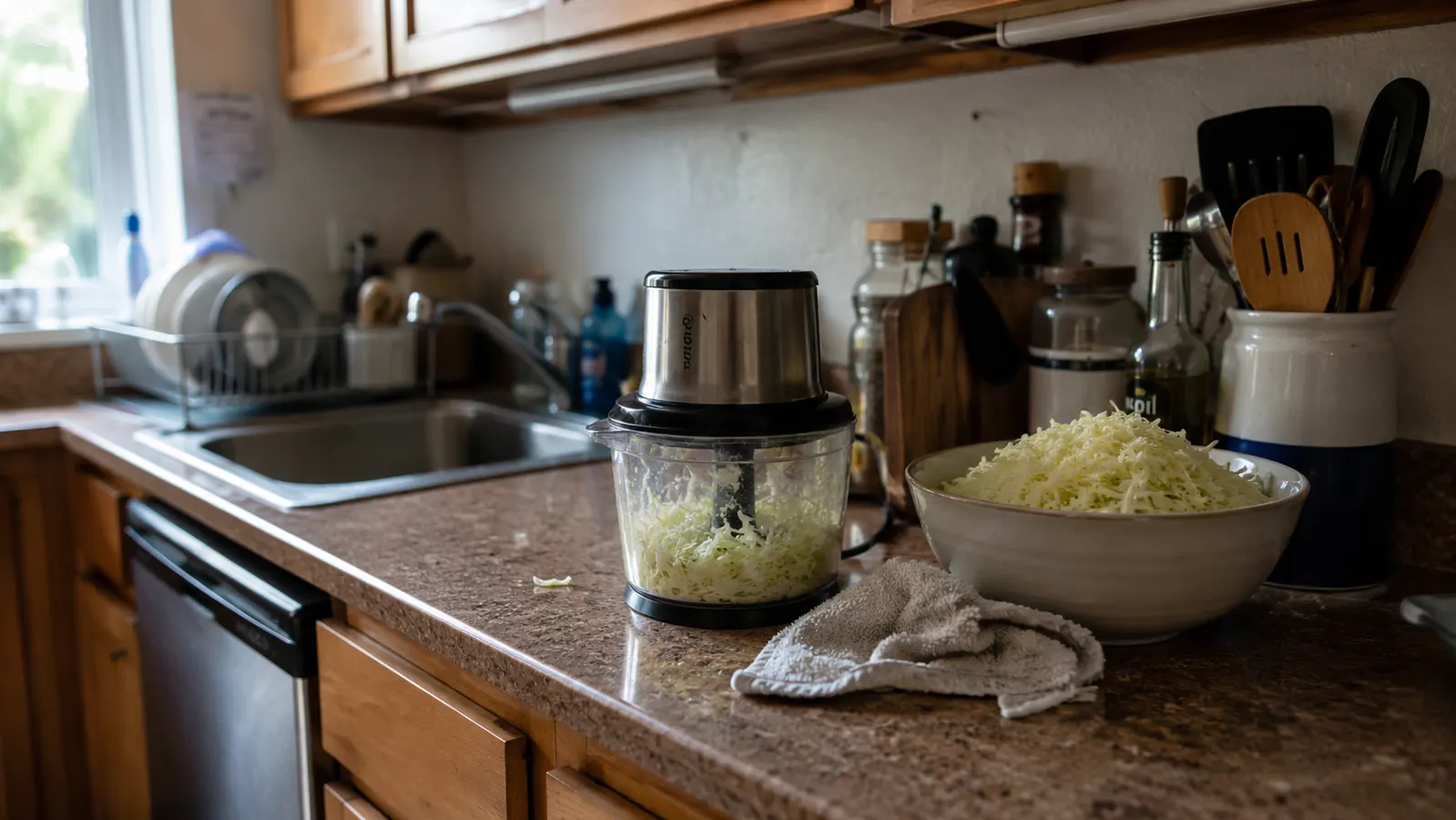
I bought the Hamilton Beach 3 Cup Electric Vegetable Chopper because of the review count, not because a friend recommended it. 36,806 reviews and a 4.6-star average is hard to argue with when you're standing in a kitchen with one run of counter, about six feet total, and no room to gamble on a gadget that might not earn its keep. Eleven weeks later I still reach for it most weeknights, but nobody who left one of those five-star reviews mentioned the things I actually needed to know before I bought it: how small "3 cup" really is once you're prepping for more than one person, how loud the motor sounds at seven in the morning, and how fast the lid seal starts letting liquid through.
At today's price the Hamilton Beach is one of the least expensive appliances on my counter, and the low price is part of what pulled me in alongside the rating. A clear bowl, one stainless steel blade, a white base, a press-to-run lid with no dial and nothing to program. That simplicity is real and it is a genuine selling point. But simple isn't the same as flawless, and after using it nearly every day for cabbage slaw, hard-boiled eggs for egg salad, breadcrumbs, and the usual onion and garlic, I've got a running list of things I wish someone had told me on day one instead of leaving me to find out the hard way.
The Quick Verdict
A genuinely useful chopper for one or two people, but the 3-cup bowl is more marketing number than usable capacity, the lid seal wears sooner than you'd expect, and the motor has real limits that the listing photos never show.
Amazon Check Today's Price →Before you trust the star rating, know what it doesn't tell you
36,806 reviews and 4.6 stars sound like a sure thing. They don't tell you the bowl fits less than you'd guess or that the seal needs babying by week six. See today's price and read the honest version first.
Amazon Check Today's Price on Amazon →What the Five-Star Reviews Don't Mention
The first thing that surprised me wasn't the chopping, it was the noise. This runs louder than I expected for something this small, closer to a stick blender than a quiet kitchen tool, and it's loud enough that I've stopped using it before seven in the morning out of consideration for the apartment next door. None of the product photos or the bullet points on the listing page mention this, and it's the kind of thing you only find out once the box is open and you press the lid down for the first time.
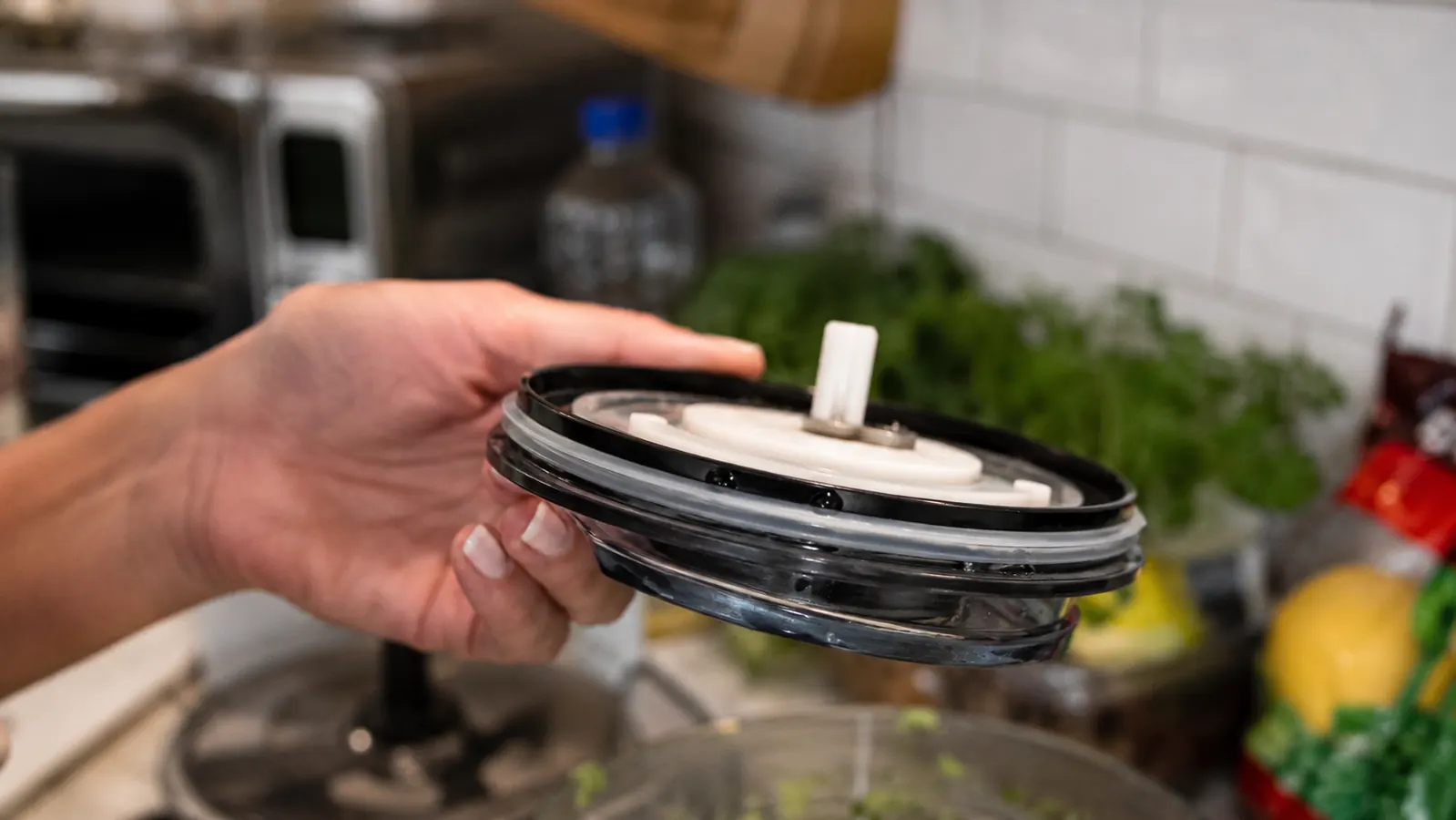
The second thing is the lid seal. It works fine out of the box, no complaints for the first month or so, but by week six I started noticing a thin bead of liquid escaping around the edge whenever I chopped anything wet, cabbage with any moisture in it, a tomato, a peeled cucumber. It's not a flood, just a few drops that end up on the counter under the base, but it means I now chop wet ingredients over a towel out of habit, which is a workaround nobody warns you about in a five-star review written the week the box arrived.
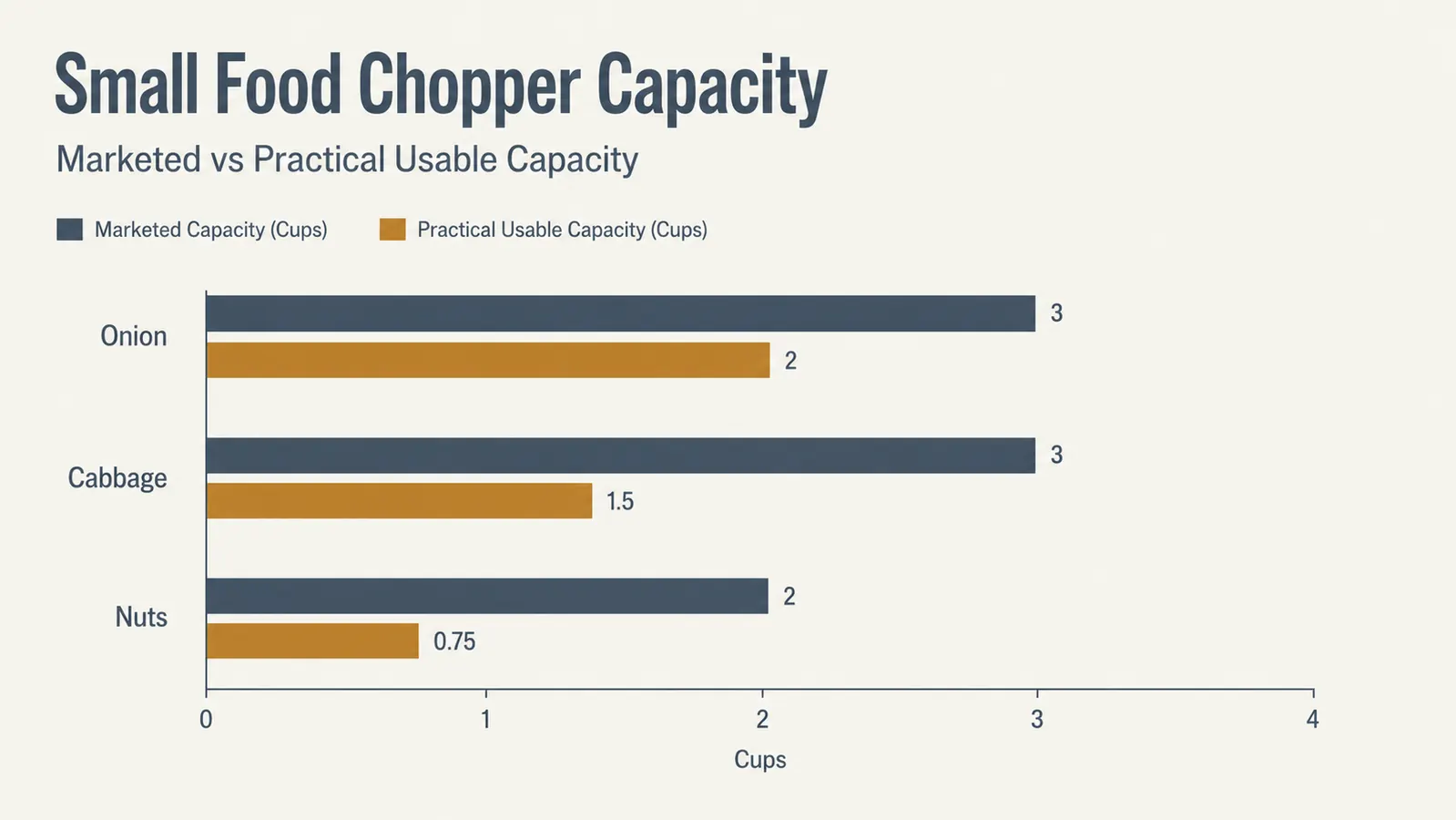
The third thing, and the one that annoyed me most, is that the bowl fills up faster than the "3 cup" label suggests. A single medium onion looks like it should leave room to spare in a 3-cup bowl. In practice, once you account for the blade housing that sits in the middle and takes up real volume, one onion fills it to a point where the pieces on top don't get consistent contact with the blade. I didn't understand why my first few batches came out uneven until I started underfilling the bowl on purpose.
The Real Capacity, Not the Marketing Capacity
Here's the number that actually matters if you're deciding whether this fits your cooking: the practical usable fill line is closer to two cups than three, once you leave room for the blade to spin freely and get even contact with every piece. I measured this out of frustration after a batch of coleslaw came out half-shredded, half-whole. Quartered cabbage, filled to the marked 3-cup line, ran for fifteen seconds and left visible chunks that hadn't touched the blade at all. Dropped back to about two cups and pulsed the same fifteen seconds, and it came out even.
That gap between marketed and usable capacity is the single biggest thing I wish I'd known before ordering. If you're cooking for one or two people and mostly chopping onion, garlic, or a handful of herbs at a time, the real capacity is genuinely enough and you'll rarely notice the difference. If you regularly need a full head of cabbage for slaw, three or four hard-boiled eggs for egg salad, or a cup and a half of breadcrumbs, you're doing two or three batches every time, not the one batch the "3 cup" label implies on the box.
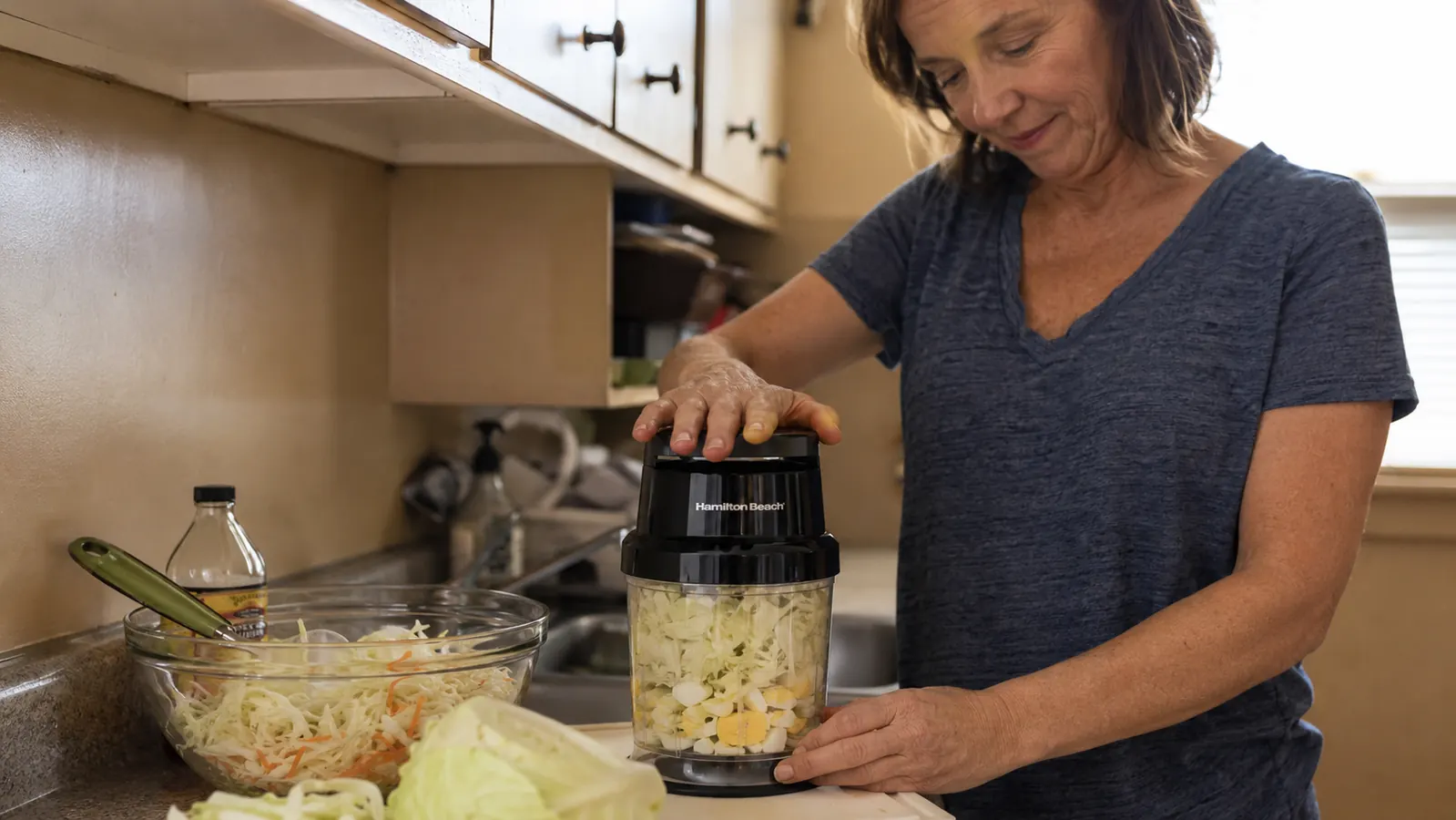
Egg salad is where this showed up most clearly for me. Four hard-boiled eggs look like they'd fit easily in a 3-cup bowl. They don't chop evenly at that volume, some pieces turn to paste while others stay in halves, and I've settled on doing two eggs at a time, dumping into a serving bowl, then repeating. It works, but it's an extra ninety seconds and an extra bowl to wash that the marketing number never accounted for.
Motor Power: Where It's Honest and Where It Isn't
For soft to medium ingredients, onion, garlic, soft herbs, boiled eggs, ripe tomato, the motor is honestly stronger than I expected for the price. It chews through a clove of garlic in two or three short presses without bogging down or straining, and it never once smelled hot or slowed mid-batch on anything in that category, even run back to back for a big batch of pesto over a weekend.
Where the motor stops being honest with itself is anything dense or dry. I tried it on a half cup of raw almonds hoping for a rough chop for granola, and it strained audibly, the pitch of the motor dropping the way a vacuum does when it hits something too big for the hose. I stopped after about twenty seconds out of concern for the motor rather than push it further, and the almonds came out unevenly, some in near-powder, others barely cracked. Breadcrumbs from stale bread had the same problem, dry ingredients without enough moisture to help the blade cut cleanly tend to bounce around the bowl instead of getting sliced.
The listing photos show this chopper handling everything from meat to ice, and I want to be direct about what I actually tested rather than what the box implies. Frozen ginger, a small chunk about the size of a thumb, took nearly a full minute of pressing in short bursts and came out in stringy shreds rather than a clean mince. Raw chicken, which I tried once for a quick batch of ground meat for tacos, chopped unevenly and I don't recommend using it for raw meat at all given how hard it is to fully clean the gasket and the crevice around the blade hub afterward.
The Parts That Wear Faster Than You'd Think
I expected the blade to be the weak point on a budget chopper. It hasn't been. Eleven weeks of near-daily use and it still minces garlic cleanly, no dulling that I've noticed. What's actually worn faster than I expected is the rubber gasket around the lid, the same one responsible for the leaking I mentioned earlier, and the four small rubber feet on the base, two of which have started to peel slightly at the edge where they meet the plastic housing.
The peeling feet matter more than they sound like they should. This chopper relies on those feet to stay put on the counter while you press down with real force, and by week eight I noticed it sliding an extra half inch or so during a hard press, something that never happened in the first month. It hasn't slid off the counter or caused a real problem, but it's a change I can feel and one I'll be watching, because a chopper that slides while you're pressing straight down is a chopper you have to hold steady with your other hand, which defeats some of the point of a press-to-run design.
The lid lock tab, the small plastic piece that has to click into place before the blade will spin, has stayed solid for me so far, no looseness at eleven weeks. I mention this because it's the one part that showed wear fastest in other long-term reports I've read on this model, so if yours starts developing a bit of play in the lock mechanism after a few months, you're not alone and it isn't a sign you got a defective unit.
What I Wish I'd Known Before I Bought It
The bowl, lid, and blade are labeled dishwasher-safe, and they are, but I've learned to put them on the top rack only. I ran the base's blade assembly through a bottom-rack cycle once by mistake and the plastic housing around the blade came out slightly warped, not enough to affect function, but enough that the lid now needs a firmer press to seat correctly than it did before that wash.
I also wish I'd measured my outlet situation more carefully before ordering. The cord is short, close to a foot and a half, and my only free outlet sits about ten inches from where I actually prep, which is fine, but if your outlet is any farther than that from your cutting board, you'll either be prepping in a new spot or running an extension cord across your counter, which nobody wants for a daily-use appliance.
And I wish the listing had been clearer that this is a single-speed, on-off design with no pulse control beyond how hard and how long you press. That's fine for most jobs, but it means there's no way to slow down and rescue a batch that's starting to turn to mush, the way a variable-speed processor lets you. Once cabbage or onion crosses from chopped to mush, there's no walking it back, and that only became obvious to me after ruining a batch of slaw in my second week.
A Cheaper Alternative I Tried First
Before this, I owned one of the pull-string manual choppers, the kind where you yank a cord on top and a spring-loaded blade spins for a second or two. It cost less than half what this one runs today, and I want to be fair to it: it worked on soft, small jobs. Where it failed me consistently was anything with volume, a full onion took eight or nine pulls and still came out uneven, and my wrist was sore after a week of nightly use from the repeated yanking motion.
Switching to the Hamilton Beach solved the wrist problem completely and cut my actual prep time roughly in half, even accounting for the second-batch issue with bigger volumes. It was the right upgrade for me. But I don't want to oversell it as a dramatic leap either, it's still a small, single-blade chopper with real limits, not a step up to a true food processor with attachments and a bigger bowl. If your prep needs are bigger than mine, weigh that honestly before assuming this solves everything the pull-string version couldn't.
What I Liked
- Handles onion, garlic, soft herbs, and boiled eggs cleanly with real motor power for the price
- Genuinely compact, easy to store and pull out daily without ceremony
- No dial or pulse control to learn, press-to-run is simple for anyone in the household
- Blade has stayed sharp through eleven weeks of near-daily use, no dulling noticed
Where It Falls Short
- Marketed 3-cup capacity is closer to 2 cups of usable, evenly-chopped volume
- Lid gasket started leaking a small amount of liquid with wet ingredients by week six
- Rubber feet on the base show early peeling and reduced grip by week eight
- Struggles with dry or dense ingredients like nuts, breadcrumbs, and frozen ginger
- Runs louder than the listing suggests, not ideal for early-morning prep in thin-walled apartments
The rating pulled me in. The real usable capacity, the leaking seal by week six, and the peeling feet by week eight are the parts that actually decide whether it earns its spot, and none of that shows up in a five-star review written the day the box arrived.
Who This Is For
The Hamilton Beach still earns its spot in my kitchen, and it's the right buy for a small kitchen where the appliance has to handle daily onion, garlic, and herb prep for one or two people without demanding real counter space. If your cooking mostly stays within a single onion's worth of volume per meal, the capacity gap barely matters and the low price and simple operation make it an easy win over hand-chopping or a pull-string alternative.
Who Should Skip It
If you cook for a family and regularly need a full head of cabbage, several cups of nuts, or big batches of anything in one pass, the real usable capacity will frustrate you faster than the label suggests it should. If you bake often and want dry ingredients like breadcrumbs or ground nuts handled cleanly, or if noise is a genuine concern in your living situation, look at a step up with a bigger bowl and a stronger motor instead. And if you wash everything on a bottom rack out of habit, be ready to hand wash the blade housing or risk the same slight warping I ran into.
Now you know what the five-star reviews leave out
It still earns its spot on my counter for daily onion, garlic, and egg salad prep, real capacity and all. See today's price before you decide whether the tradeoffs work for your kitchen.
Amazon Check Today's Price on Amazon →