

The BLACK+DECKER TO1313SBD toaster oven has lived on the same stretch of counter next to my stove for just over a year now, and it has earned every inch of that space. I moved into this apartment last June with a galley kitchen that gives me one run of counter, about six feet total, no island, no pantry, nowhere to tuck a second oven's worth of gear. When my old two-slice toaster died in July, I didn't want another toaster. I wanted something that could also bake a small tray of vegetables, reheat leftover pizza without turning the crust to cardboard, and toast a bagel without me standing over it. The TO1313SBD does all three, and after twelve months of near-daily use I can tell you exactly where it earns its spot and where it comes up short.
At today's price, it sits at the budget end of countertop ovens, and it looks it: brushed silver plastic, a mechanical timer dial, no digital display, no app. That's fine by me. I've watched smarter kitchen gadgets die because a firmware update stopped talking to a phone, and a mechanical dial never needs an update. What matters more is that it measures 15.47 inches wide, which is the exact number I taped off on my counter before I ordered it, and it fits under my upper cabinet with about two inches of clearance on top, so I never have to slide it out just to open the door.
The Quick Verdict
A reliable 4-slice toaster oven that earns a permanent spot on a tight counter, if you accept that the middle rack runs hotter than the edges and plan your loading around it.
Amazon Check Today's Price →Still heating a full oven for two slices of pizza?
The TO1313SBD replaced my full-size oven for anything under a sheet pan's worth of food. See today's price and current availability before you decide.
Amazon Check Today's Price on Amazon →How I've Used It This Past Year
In a typical week I run the BLACK+DECKER eight or nine times: bagels most mornings, reheated leftovers three or four nights, and a Sunday batch of roasted vegetables or a small tray of chicken thighs. It replaced my toaster completely and it replaced my full-size oven for anything that doesn't need to feed more than two people. I stopped preheating the big oven for a single sweet potato or four cookies months ago. The toaster oven gets there faster and doesn't heat up the whole kitchen in August, which matters when your kitchen and living room share the same air.
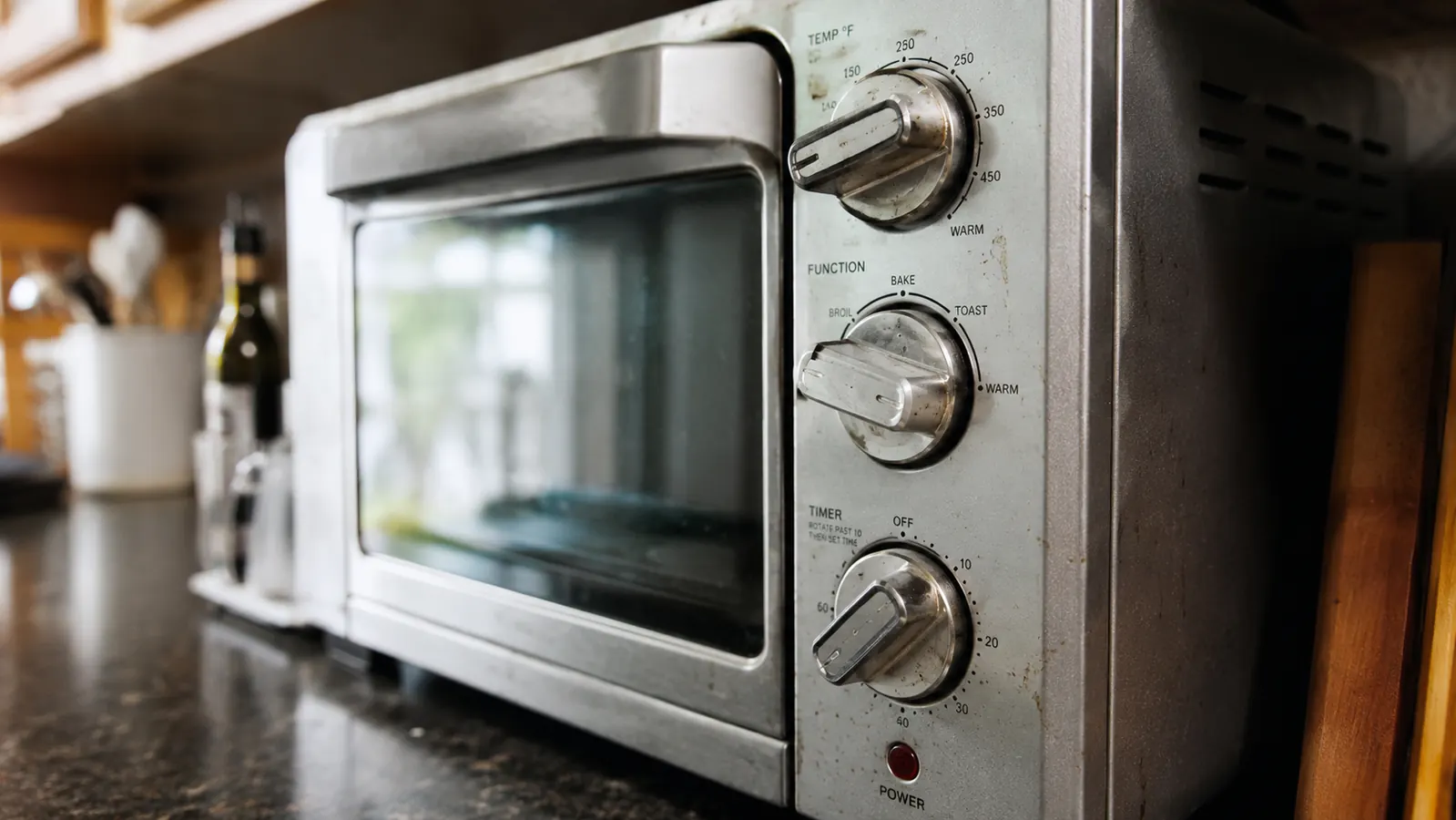
The toast function is what I use most, and it's straightforward: a shade dial from light to dark, a lever to start it, and a bell that dings when it's done. No guessing at a digital number that doesn't match what actually comes out. The bake and broil settings are separate dial positions with a temperature knob that goes up to 450 degrees. I use bake for anything under thirty minutes and broil maybe once a week, usually for finishing cheese toast or crisping the skin on chicken thighs after they've mostly cooked through.
The interior fits a 9-inch pizza or four slices of bread at once, which was the number I needed. I looked at smaller 2-slice models before buying and they were cheaper, but they couldn't fit a full sheet of leftovers or a small casserole dish, and I knew from my old apartment that a toaster that only toasts ends up living in a cupboard. This one earns its counter spot because it does three jobs instead of one.
The Footprint: What 15.47 Inches Actually Gets You
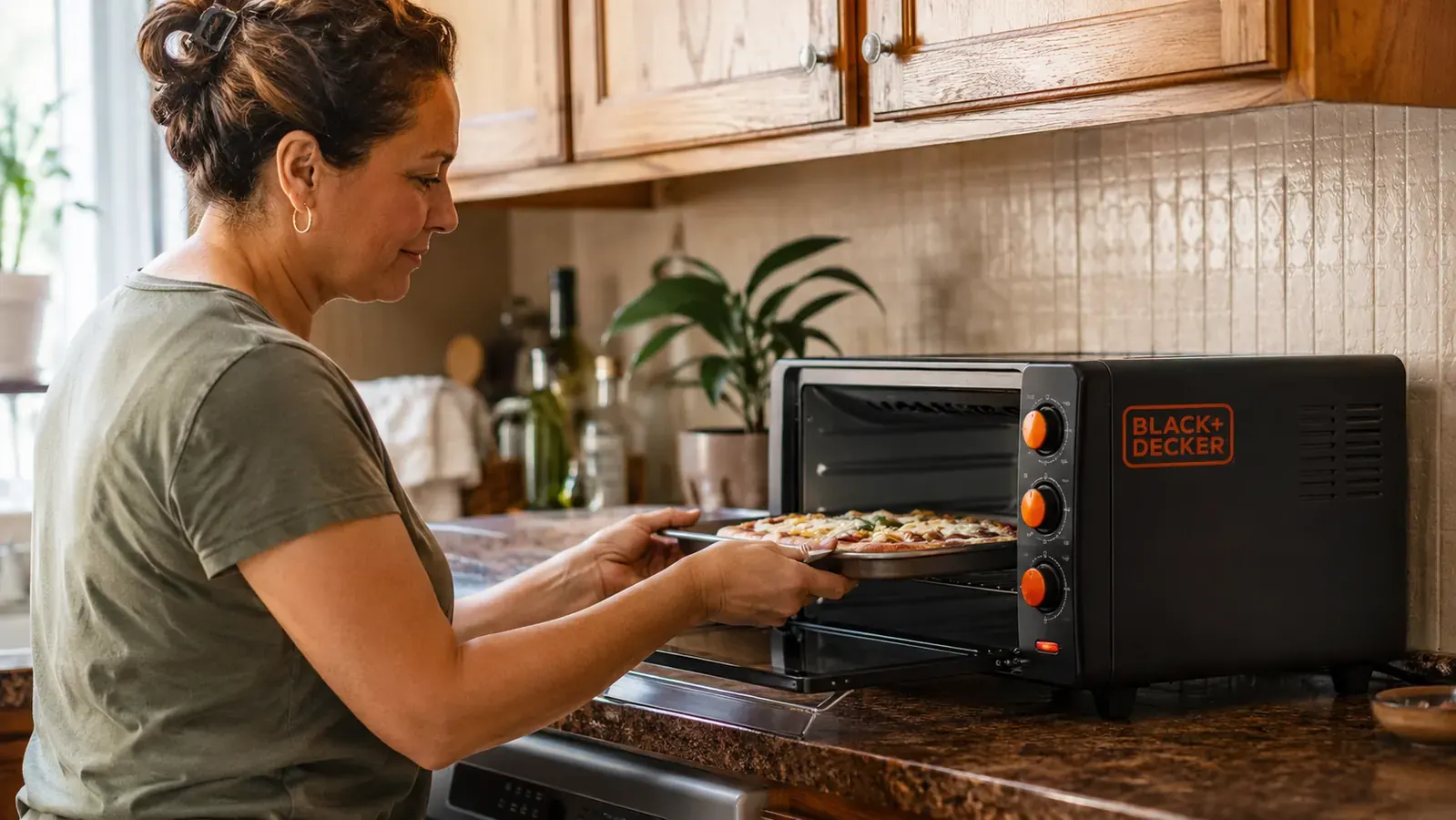
I measured twice before I bought this, because in my last apartment I bought a toaster oven that was two inches too deep and it stuck out past the edge of the counter, catching my hip every time I walked past. The BLACK+DECKER TO1313SBD is 15.47 inches wide, roughly 11 inches deep, and about 8 inches tall with the door closed. On my counter that leaves about four inches of clearance to the edge of my four-burner stove, enough that a pot handle doesn't hit it when I'm cooking both at once.
It weighs close to nine pounds, light enough that I can lift it down and wipe underneath it once a month without asking anyone for help, but heavy enough that it doesn't slide around when I open the door. The crumb tray pulls out from the front, which matters more than it sounds like it should. My old model had a side-loading tray and I could never get it out without pulling the whole unit away from the wall first.
I also considered not replacing my counter appliance at all and just using the full-size oven for everything, the way I did in my first apartment. That lasted about two weeks before the electric bill and the summer heat talked me out of it. A dedicated toaster oven this size uses a fraction of the energy and doesn't turn my kitchen into a sauna to reheat a burrito.
Heat Evenness and the Toast Test
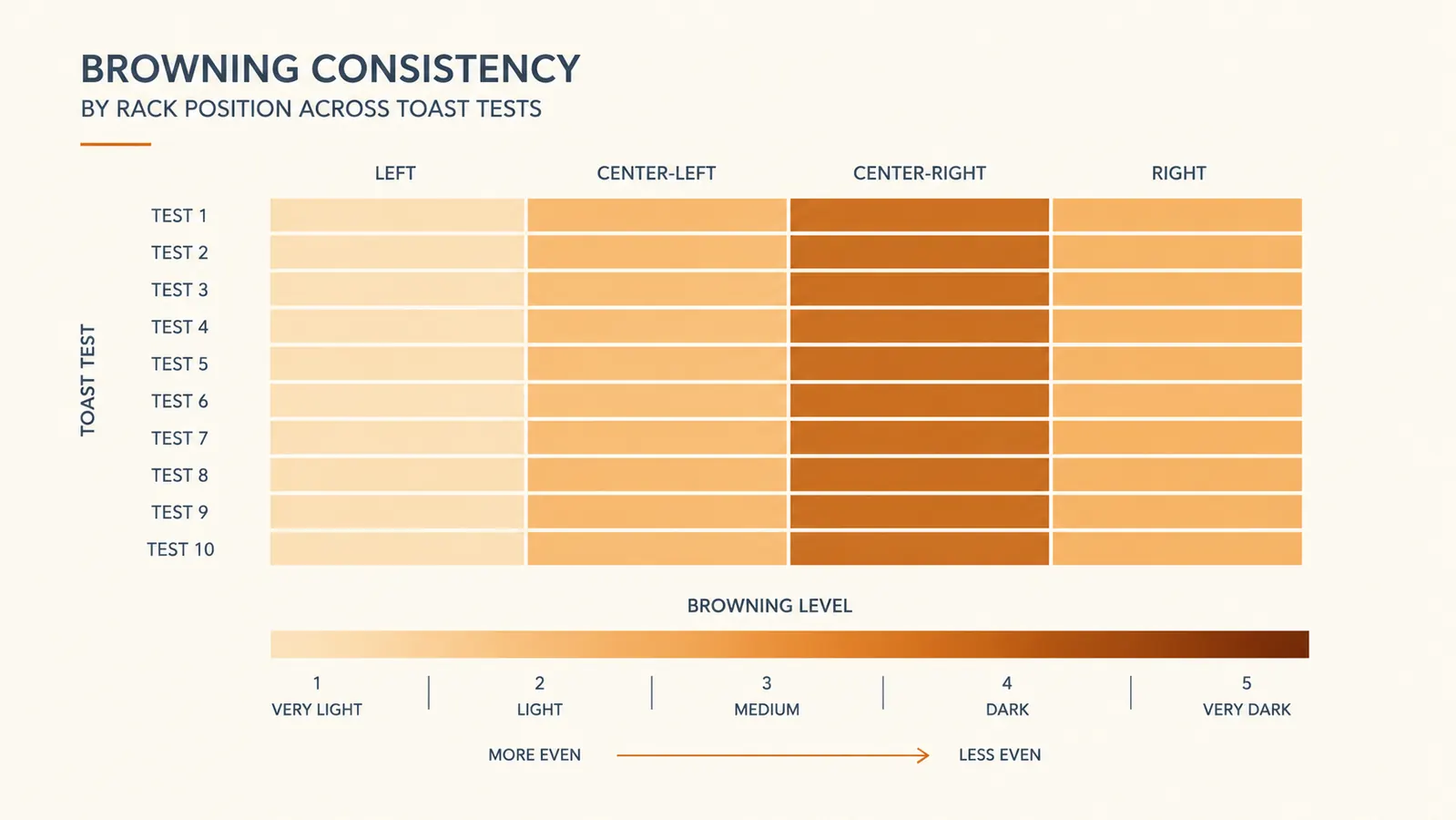
My standard test for any toaster is four slices of the same bread, same shade setting, run at the same time. On the TO1313SBD, the two middle slots come out noticeably darker than the two on the outer edges, close to a full shade level darker on the setting I use most. It's not ruinous, but it's consistent enough that I now load lighter bread on the outside and darker bread in the middle if I'm doing a mixed batch, or I just rotate the tray halfway through if I want everything matching.
Broiling shows the same pattern. A tray of cheese toast browns fastest directly under the center of the heating element, so I've learned to check at the halfway mark and turn the tray rather than trust the timer alone. This isn't unusual for an oven in this price range, single heating elements on top and bottom rarely distribute heat as evenly as a convection fan would, but it's worth knowing going in rather than finding out with a burnt edge on a nice fillet.
Baking is more forgiving because most of what I bake, roasted vegetables, a small casserole, a tray of six cookies, sits long enough at a lower temperature that the hot spot evens out over the full cook time. It's really the short, high-heat jobs, toast and broil, where the unevenness shows up. Once I understood that, it stopped bothering me.
Daily Use: Reheating, Baking, Broiling
Reheated pizza is where this oven changed my habits the most. A slice or two goes on the middle rack at 350 for about six minutes and comes out with a crust that's actually crisp again, not the soggy microwave version and not the dried-out edges I used to get from the full oven when I forgot to set a timer. I do this two or three nights a week and it's the single feature I'd miss most if the unit died tomorrow.
For baking, I keep expectations realistic. A half sheet of roasted broccoli or carrots for two people fits with room to spare. A dozen cookies does not fit, six does, comfortably, on the included rack. I've baked a small quiche in a 6-inch dish and it worked fine at 375 for about 35 minutes, though I rotated it once because of the hot-spot issue above.
Broil gets used for chicken thighs after they've spent most of their cook time on bake, a few minutes under broil crisps the skin the way a full oven's broiler would. It also handles open-faced sandwiches and the occasional bagel with cheese that I want bubbly rather than just warm. I don't use broil for anything that needs even color across a large surface, that's where the center hot spot is most noticeable.
What's Held Up After a Year (and What Hasn't)
The housing looks the same as the day I unboxed it, aside from some fingerprints on the door glass that wipe off with a damp cloth. The dials still click into place with the same resistance they had on day one, no looseness, no sticking. The interior heating elements still glow evenly across their length, which tells me the elements themselves haven't degraded.
The crumb tray shows the most wear, some discoloration from repeated heat cycles, which I expected and don't mind since it's hidden. I pull it and wipe it out roughly once a week, more often if I've been baking something with cheese that drips. The wire rack has a bit of baked-on residue in the corners that a scrub brush doesn't fully lift, purely cosmetic at this point.
The one real complaint is the door hinge, which has developed a slight wobble, the door doesn't sit perfectly flush when closed the way it did new. It still seals well enough that heat doesn't visibly escape and my cook times haven't changed, but I notice it every time I close it. At a year of daily use that feels like a fair trade for the price, though I'll be watching it closely going into year two.
Alternatives I Considered First
Before buying, I seriously considered just relying on my full-size oven and skipping a countertop unit entirely. I'd done that for two years in my first apartment out of stubbornness more than logic. It works, technically, but heating a 24-cubic-foot oven to reheat two slices of pizza or toast a bagel is wasteful in a way you feel on the electric bill every August, and it heats up a small kitchen faster than any window fan can cool it back down.
I also looked at pricier convection toaster ovens with digital displays and a fan for more even heat, including a Breville mini model that friends have recommended. The even heat is a real advantage on paper. But the footprint runs larger and the price runs well past what I wanted to spend on an appliance I use mostly for toast and reheats. For a straightforward daily driver on a tight counter, the BLACK+DECKER did what I needed without asking me to relearn a digital menu.
What I Liked
- Genuinely compact at 15.47 inches wide, fits under standard upper cabinets
- Handles toast, bake, and broil, replaced two separate appliances
- Front-loading crumb tray is easy to clean without moving the unit
- Mechanical dials with no app, no firmware, nothing to sync
- Fits a 9-inch pizza or four slices of bread at once
Where It Falls Short
- Center rack runs noticeably hotter than the outer edges
- Door hinge developed a slight wobble after a year of daily use
- No convection fan, so even browning takes some manual rotating
- Six cookies is the practical baking limit, not a full dozen
It isn't going to bake a Thanksgiving turkey, but it handled almost everything that used to make me turn on a full-size oven for two people.
Who This Is For
This is the right toaster oven for a small kitchen where the counter space is genuinely limited and the appliance has to earn its keep by doing more than one job. If you're cooking for one or two people, reheating leftovers more often than you cook from scratch, and you want a mechanical dial you never have to think about, this fits the job. It's also a solid fit for a first apartment or a dorm-adjacent setup where a full oven either doesn't exist or feels wasteful to run for small portions.
Who Should Skip It
If you're cooking for a family of four or more and regularly need to bake full trays or full-size casseroles, this oven's interior will feel small fast, look at a larger countertop convection oven instead. If perfectly even browning matters to you, for a bakery-level batch of cookies or consistent broiling across a full tray, the lack of a convection fan will bother you more than it bothered me. And if you're set on a digital display with presets, the mechanical dials here will feel dated.
One appliance, three jobs, one spot on the counter
A year in, this is still the toaster oven I reach for daily. If your counter has room for one appliance that toasts, bakes, and broils, check today's price before it changes.
Amazon Check Today's Price on Amazon →