
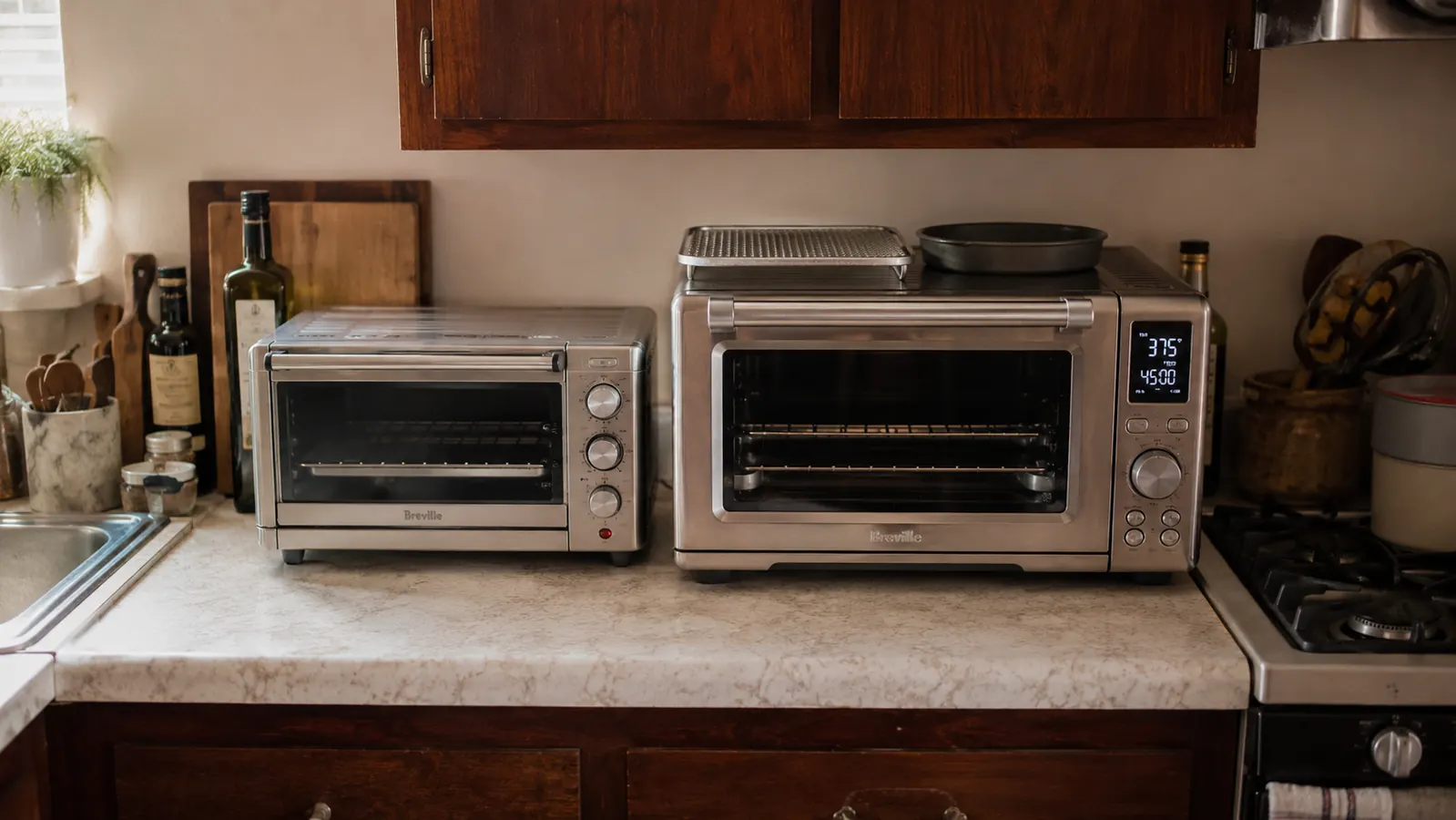
If your counter is under two feet wide, or you find yourself justifying every single appliance that stays plugged in, the BLACK+DECKER TO1313SBD is the one I'd point you to first. It costs about a third of what the Breville Mini Smart Oven runs, and it takes up almost the exact same footprint. The Breville earns its higher price back if you're cooking in it every day and want more control than a single dial gives you. That's the short answer. The long answer is six weeks of running both on my own twenty-six inch counter, and what actually separated them once the newness wore off.
I bought the BLACK+DECKER TO1313SBD first, back when I moved into a one-bedroom apartment with a single galley counter and no room for a full-size oven experiment. I used it almost daily for four months before I borrowed a friend's Breville Mini Smart Oven for six weeks to see what the extra hundred and twenty dollars actually bought. Both sat in the same spot on my counter, next to the same coffee maker, so this comparison is measured against my own eleven and a half inch depth of clearance, not a spec sheet in a store aisle.
| Spec | BLACK+DECKER TO1313SBD | Breville Mini Smart Oven |
|---|---|---|
| Footprint (W x D) | 15.47 in x 12.9 in | 15.3 in x 11.2 in |
| Weight | about 9.7 lbs | about 14 lbs |
| Capacity | 4 slices of toast, one 9-inch pizza | 4 slices of toast, one 9-inch pizza, small roasting pan |
| Controls | single analog dial, toast, bake, broil | digital touchscreen with Element iQ, 5 cooking functions |
| Preheat time (measured) | about 5 minutes to 450°F | about 3 minutes to 450°F |
| Interior light | none, door glass only | yes, turns on automatically when the door opens |
| Cleanup | removable crumb tray, hand wash rack and pan | removable crumb tray, non-stick pan, still hand wash only |
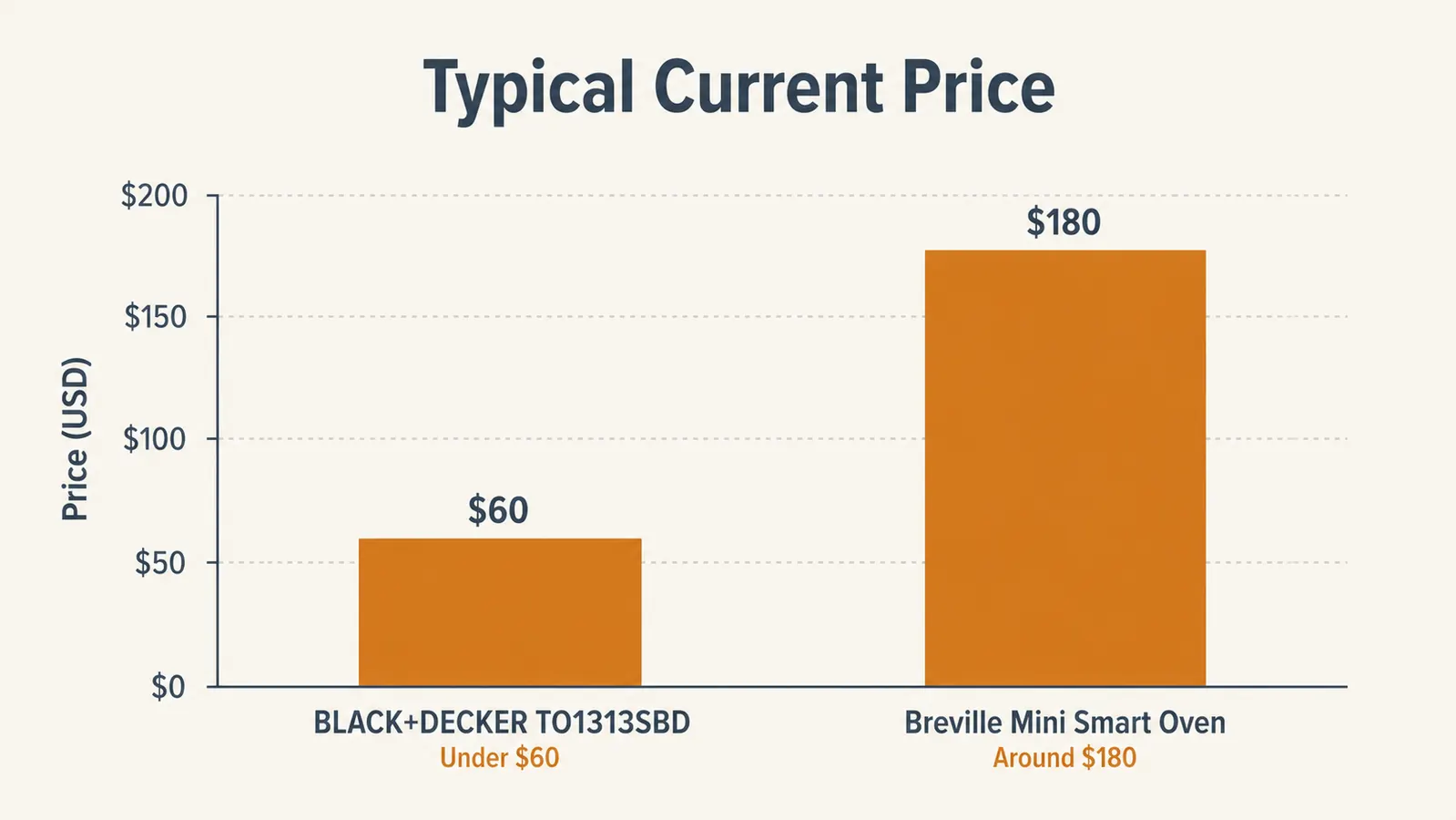
| Typical current price | under $60 | around $180 |
| Best for | renters who want the cheapest thing that still crisps toast | people who cook in it daily and want more precision than a dial |
Those numbers came from cooking the same handful of meals in both ovens over the six weeks: bagels, frozen waffles, a small tray of roasted vegetables, and a nine-inch personal pizza on a Friday night, twice, once in each oven. I used a kitchen timer instead of trusting either dial or display, because a dial can drift and a smart oven's sensor still needs a sanity check the first few times you use it. The BLACK+DECKER browned toast evenly on the top rack but needed a rotation halfway through on the bottom rack, something the Breville's more even heating mostly avoided.
I also paid attention to how long each one actually took me to use, start to finish, not just the number printed on the box. The BLACK+DECKER's dial preheats a little slower, close to five minutes to reach 450 degrees, but there's nothing to think about once it's turned. Twist the dial, set the timer, done. The Breville's Element iQ sensor preheats faster on paper and adjusts the heating elements automatically depending on what you're cooking, but the first two weeks I still found myself checking the manual to understand what each of the five settings actually changed about the cook.
Noise wasn't really a factor with either one, since neither has a fan running constantly the way a full convection oven or an air fryer does. What did surprise me was the weight difference. The BLACK+DECKER is about 9.7 pounds, light enough that I move it off the counter and into a cabinet when I have guests over and want the space back. The Breville, at closer to 14 pounds, is not something I wanted to lift in and out casually, so it stayed parked on the counter the entire six weeks, eating into space I'd normally use for a cutting board.
I also checked how each one handled the door and the crumb tray, since both of those wear out fastest on a countertop oven that gets used every day. The BLACK+DECKER's door hinge felt a little looser by the end of four months, though it never affected the seal or the cooking results. Its crumb tray slides out from the front, which meant I could empty it without pulling the whole oven away from the wall. The Breville's tray does the same, but the extra weight of the oven made me hesitate to slide it in and out on the counter more than once a week, so crumbs built up longer than I'd have liked.
None of that shows up on a spec sheet, and it's exactly the kind of detail that decides whether an appliance earns a permanent spot on your counter or ends up back in its box within a month. So before getting into where each one actually wins, know that this comparison is built on six weeks of real dinners on a real counter, not a showroom demo.
Where the BLACK+DECKER Wins
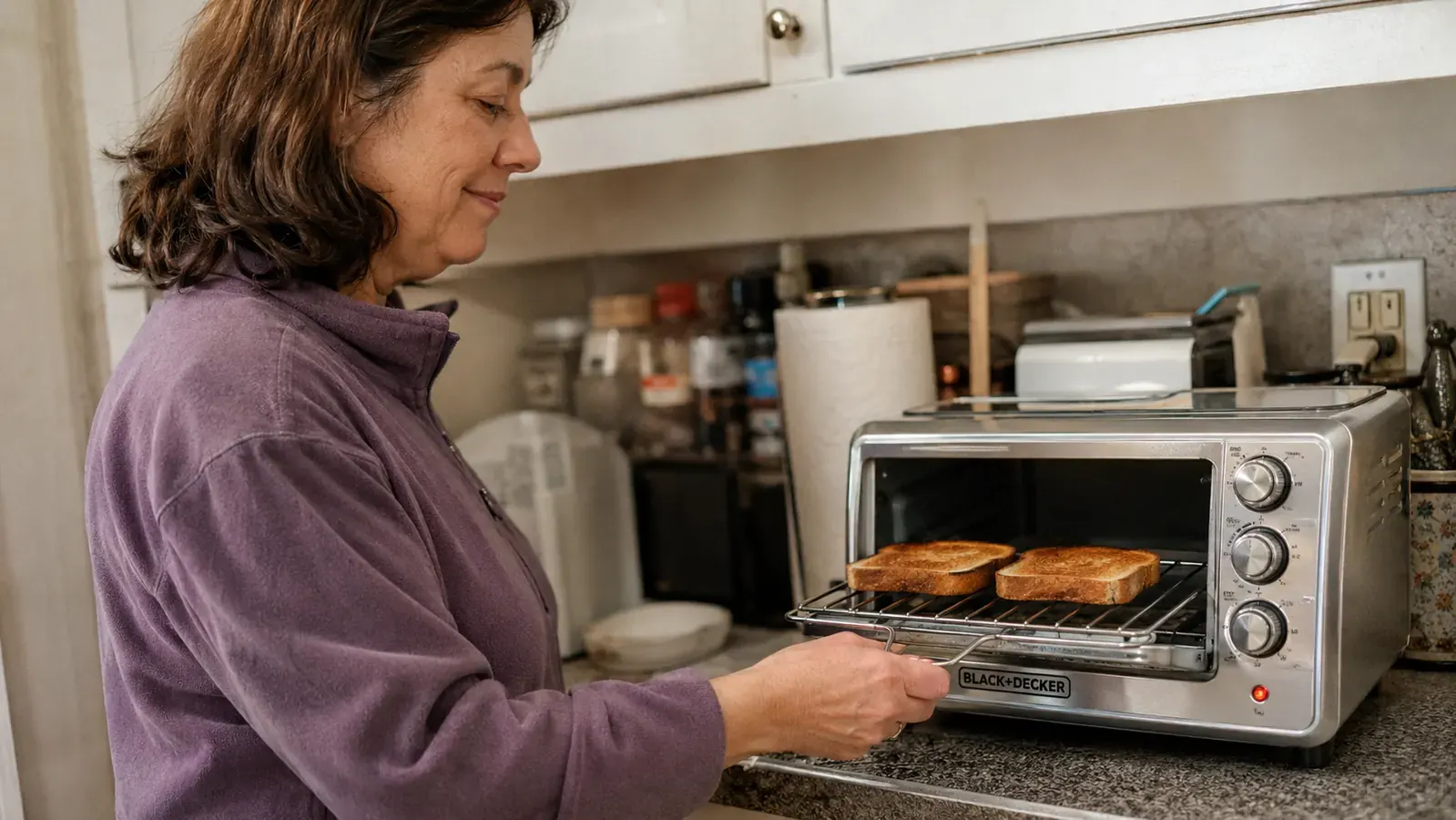
Price is the obvious one, but it's not the only one. At under sixty dollars, the BLACK+DECKER TO1313SBD costs less than a third of what the Breville runs, and for the basics, toast, bagels, reheated leftovers, a frozen pizza on a Tuesday, it does the job just as well. I never once felt like I was missing something during the four months I used it before the Breville even entered the picture. If you're outfitting a first apartment, a dorm, or a guest suite where the toaster oven isn't the centerpiece of your cooking, there's no real reason to spend the extra money.
It's also lighter and simpler to live with day to day. At 9.7 pounds, I can lift it off the counter one-handed and tuck it into the lower cabinet when I want the space back for a weekend of baking or entertaining, something I never attempted with the heavier Breville. The single dial also means nothing to learn. Turn it to bake, set the temperature, set the timer, and you're cooking within seconds of plugging it in. There's no touchscreen to wipe grease off of before it registers a tap, and no settings menu to scroll through when you're hungry and just want toast.
There's also less to worry about if it breaks. At this price, replacing the BLACK+DECKER outright costs less than most repair visits would run on the Breville, so I never felt precious about it. I've set a hot pan directly on the open door without flinching, something I still catch myself being careful about with a borrowed appliance worth three times as much sitting on someone else's counter.
Where the Breville Wins
Precision is the real tradeoff, and it's a legitimate one if you cook in a toaster oven every day rather than a few times a week. The Breville's Element iQ system reads what you're cooking and adjusts the five heating elements to match, which meant more even browning on toast and a roasted vegetable tray that came out consistently better than the same tray in the BLACK+DECKER, where I had to rotate the pan halfway through to avoid one side finishing darker than the other. If you're someone who actually roasts a small chicken or bakes cookies in your countertop oven regularly, that evenness adds up over dozens of uses.
The interior light is a small thing that turned out to matter more than I expected. Being able to see through the glass without opening the door and losing heat meant I checked on food more often and burned fewer things during that six-week stretch than I typically do in the BLACK+DECKER, where I'm squinting through a darker window or just cracking the door to look. The five cooking functions also mean the Breville can genuinely replace more of what a full-size oven does, which matters if you've downsized kitchens entirely and this is now your only oven rather than a backup to a stove-top range.
It also just looks and feels like a more finished appliance, which matters if your kitchen is open to a living room the way mine is. The brushed steel finish and the quieter click of the touchscreen fit better next to a stand mixer or a nice coffee setup than a plain silver dial-and-door box does. That's a cosmetic point, not a functional one, but for a small kitchen where every appliance is on permanent display instead of hidden in a pantry, it's not nothing.
The one that earns its spot without the extra hundred dollars
For toast, bagels, and the everyday basics, the cheaper oven does the same job. See today's price on the BLACK+DECKER TO1313SBD.
Amazon Check Today's Price on Amazon →I could lift the BLACK+DECKER off my counter one-handed. I never once tried that with the Breville.
Who Should Buy Which
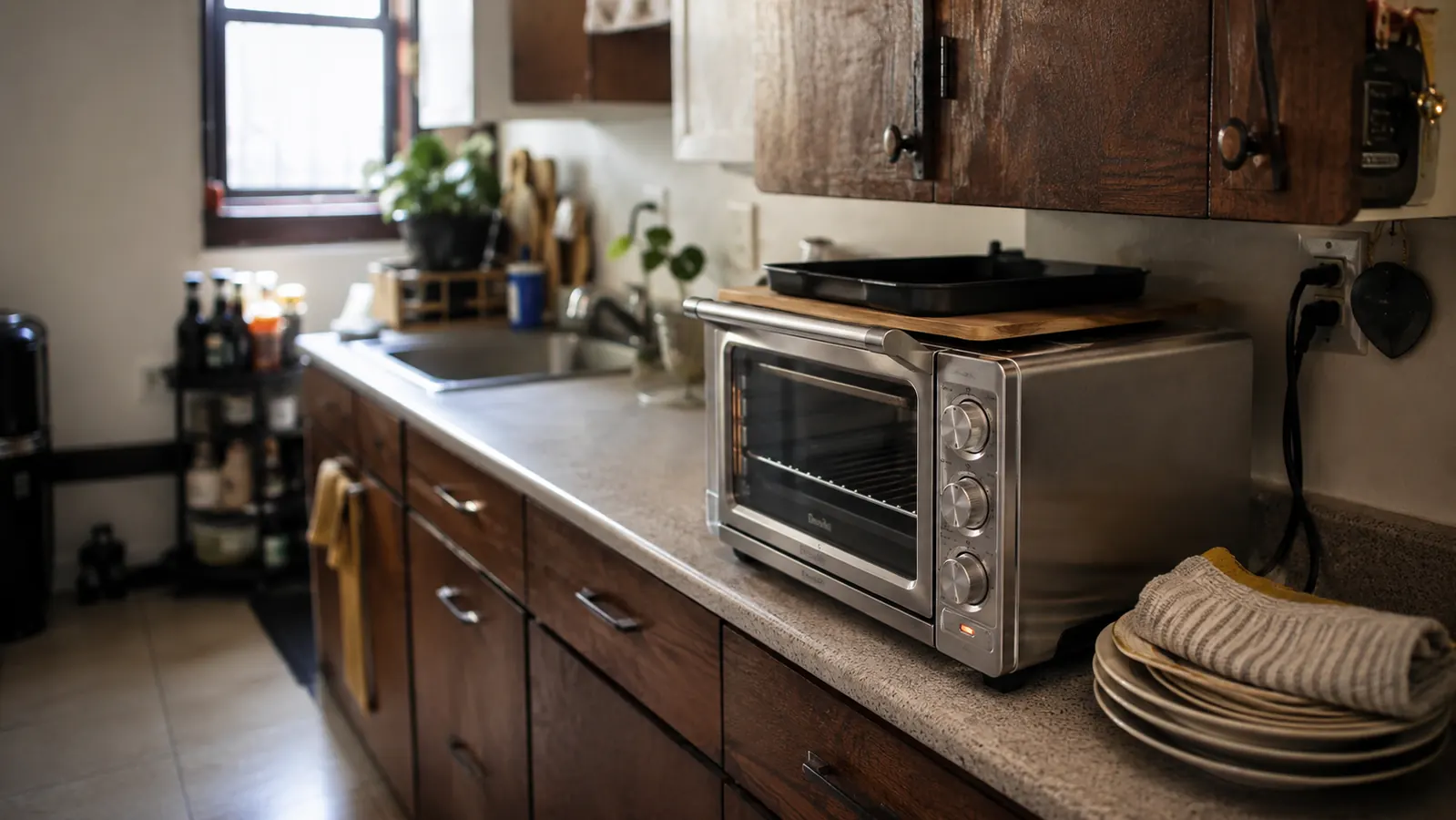
If your kitchen has one run of counter and this oven is mostly handling toast, bagels, reheated leftovers, and the occasional frozen pizza, the BLACK+DECKER TO1313SBD is the more honest buy. It's lighter, it's a third of the price, and in four months of daily use before the Breville ever showed up, I never felt like I was missing a feature I actually needed. If you're outfitting a first apartment, a dorm, or a rental where the kitchen itself might change in a year, the lower price and lighter weight make it the easier appliance to commit to.
If you cook in your countertop oven every day, roast vegetables or small cuts of meat regularly, or you've downsized to a kitchen where this is genuinely your only oven rather than a backup to a full-size range, the Breville's extra precision and interior light are worth the higher price. Just weigh that against the nearly five extra pounds you'll be lifting on and off the counter, or more realistically, the counter space it'll occupy permanently once you stop lifting it at all, which is what happened in my own kitchen within the first two weeks of borrowing one.
There's also a middle case worth naming: if you're not sure yet how often you'll actually use a countertop oven, start with the cheaper one. I've watched people spend on the higher-end appliance first, use it twice a month, and quietly resent the counter space it holds hostage. Buying the BLACK+DECKER first and upgrading later, once you actually know your own habits, costs less overall than guessing wrong on the expensive one up front.
Either way, measure your own counter before you decide, not just the price tag or the feature list. An oven that's too heavy to lift down from a shelf is one you'll eventually leave out permanently, whether or not you actually have the room to spare. I've watched enough good appliances take over counters they were never meant to live on to trust that measurement over a spec sheet every time.
Measure your counter, then decide
Fifteen and a half inches wide is the number that matters if your kitchen is small. Check today's price on the BLACK+DECKER TO1313SBD and see if it fits yours.
Amazon Check Today's Price on Amazon →