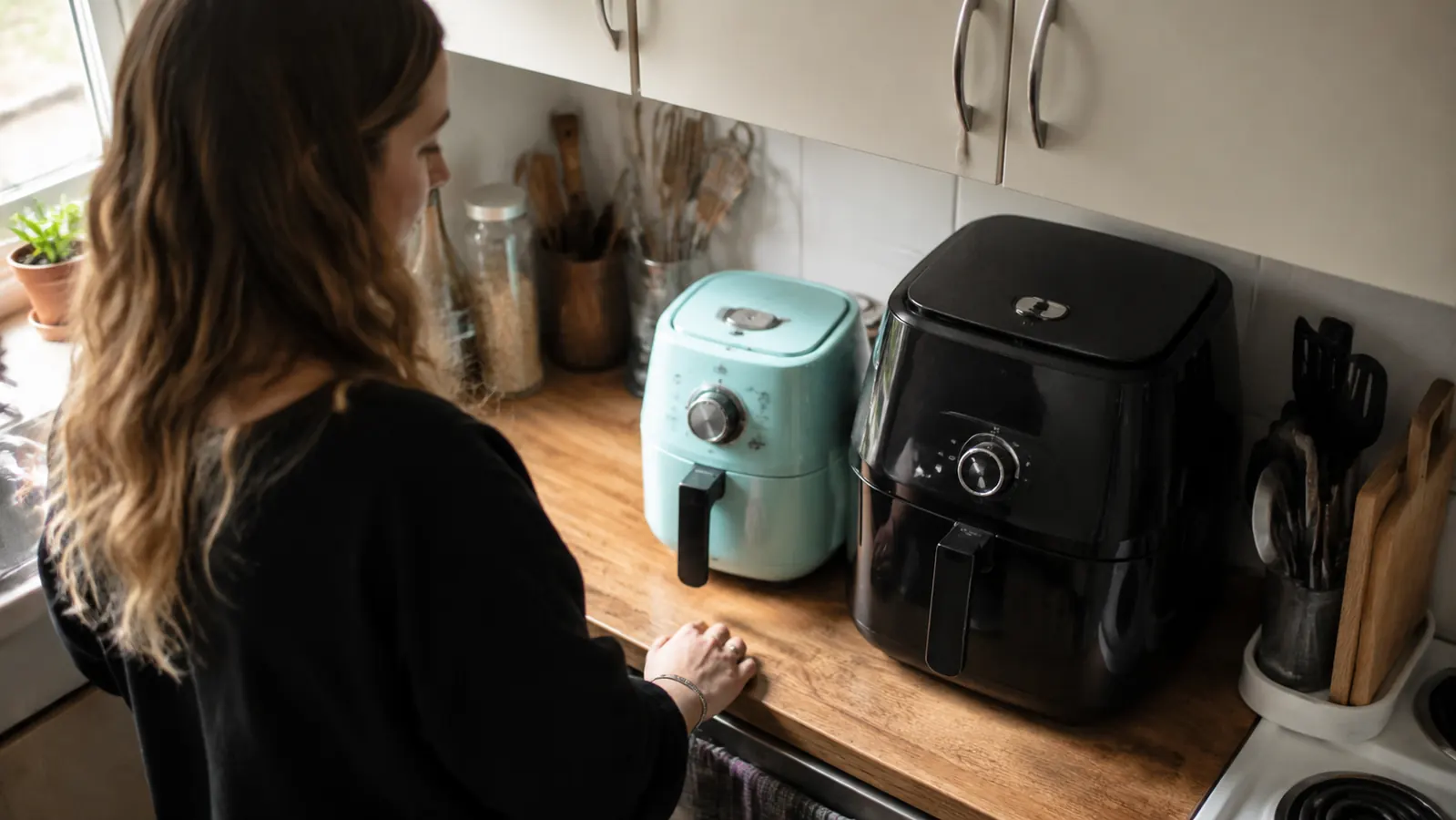
If you've got the counter for it, the Ninja wins on raw capacity almost every time. If you don't, the DASH Tasti-Crisp is the one that actually stays out on the counter instead of getting shoved in a cabinet after two weeks. That's the short answer. The long answer is about eleven inches of counter depth I didn't have to spare, and it's why I ended up testing both in my own kitchen before I'd recommend either one to anyone with a small footprint to work with.
I live in a one-bedroom apartment with a single run of counter, twenty-four inches between the stove and the wall. Every appliance I own has to justify its footprint or it goes back in the box. I bought the DASH Tasti-Crisp 2.6 Quart first, used it daily for six months, then borrowed a friend's Ninja Air Fryer for three weeks in the spring to see what I was actually giving up by staying small. This is that comparison, measured with a tape measure against my own counter, not lifted off a spec sheet in a store.
| Spec | Dash Tasti-Crisp 2.6 Qt | Ninja Air Fryer (4-Qt AF101) |
|---|---|---|
| Footprint (W x D) | 8.7 in x 11 in | 11.5 in x 12.75 in |
| Weight | about 6 lbs | about 10.6 lbs |
| Basket capacity | 2.6 quarts, 1-2 servings | 4 quarts, 3-4 servings |
| Basket style | round pull-out drawer | square-ish ceramic-coated basket |
| Controls | single analog dial, temp + timer | digital touchscreen, 4 cook presets |
| Cleanup | basket dishwasher-safe, hand-dry in under a minute | basket and crisper plate dishwasher-safe but bulkier to fit in a small sink |
| Noise while running | quiet, low steady hum | noticeably louder fan, audible from another room |
| Typical current price | under $45 | over $100 |
| Best for | 1-2 people, tight counters | families of 3-4, more counter to spare |
Those numbers came from three weeks of cooking the same handful of meals in both machines: frozen fries, brussels sprouts, chicken thighs, and reheated pizza slices. I weighed the food both times so the comparison wasn't just a feeling by the end of the week. A pound of fries filled the Dash's basket to the point where I had to shake it twice for even browning. The same pound barely covered the bottom of the Ninja's basket in a single loose layer, which is the clearest single fact in this whole comparison.
I also timed how long each one actually took me to use start to finish, not just the cook time printed on the box. The Dash preheats in about three minutes and I can have it wiped down and back to sitting quietly on the counter in under two more. The Ninja preheats a little faster on paper, closer to two and a half minutes, but between lifting it off its shelf, plugging it in, and finding counter space to set it on, my real start-to-finish time was longer with the Ninja most nights, not shorter.
I even paid attention to noise, since my kitchen opens straight into the living room and I'm usually cooking while someone's on a phone call ten feet away. The Dash runs at a low, steady hum I can talk over without raising my voice. The Ninja's fan is noticeably louder, enough that my roommate asked twice during the three weeks whether something in the kitchen was broken. It wasn't. It was just doing its job at a higher volume than I was used to.
None of that shows up on a spec sheet, and it's the exact kind of thing that decides whether an appliance gets used four nights a week or four nights a year. So before we get into where each one wins outright, know that this comparison is built on actual dinners cooked on a real counter, not a showroom demo.
Where the Dash Tasti-Crisp Wins
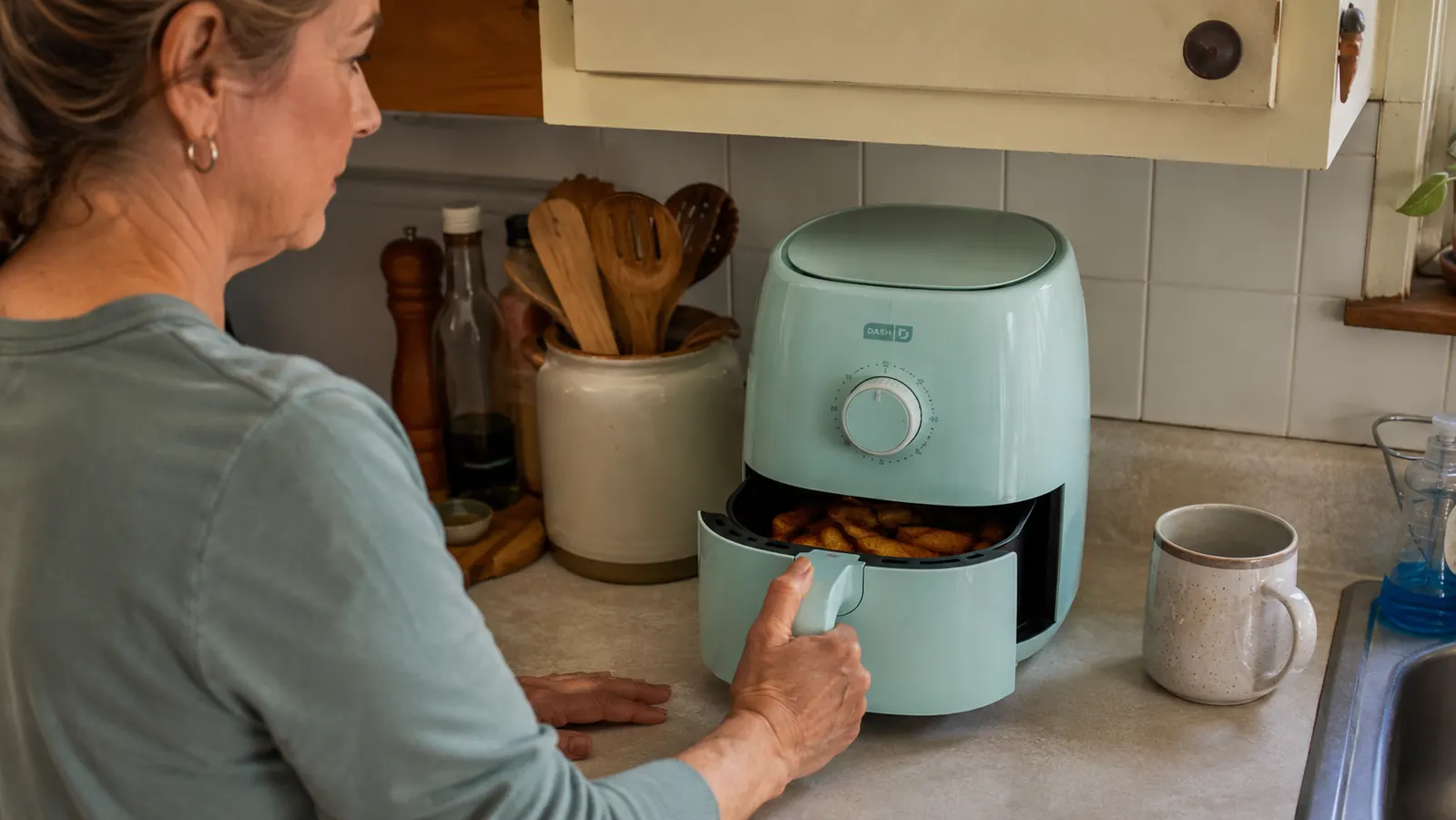
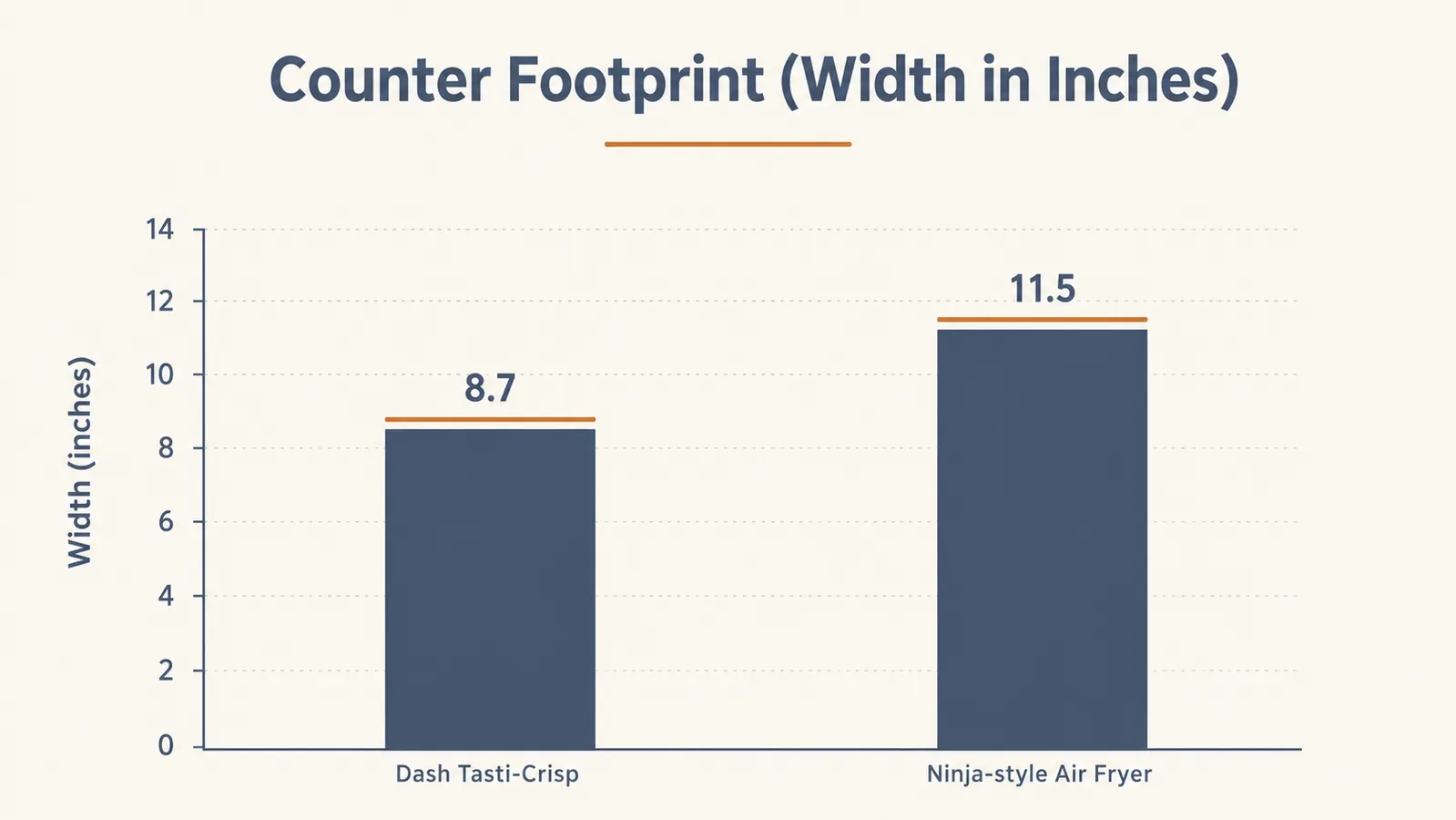
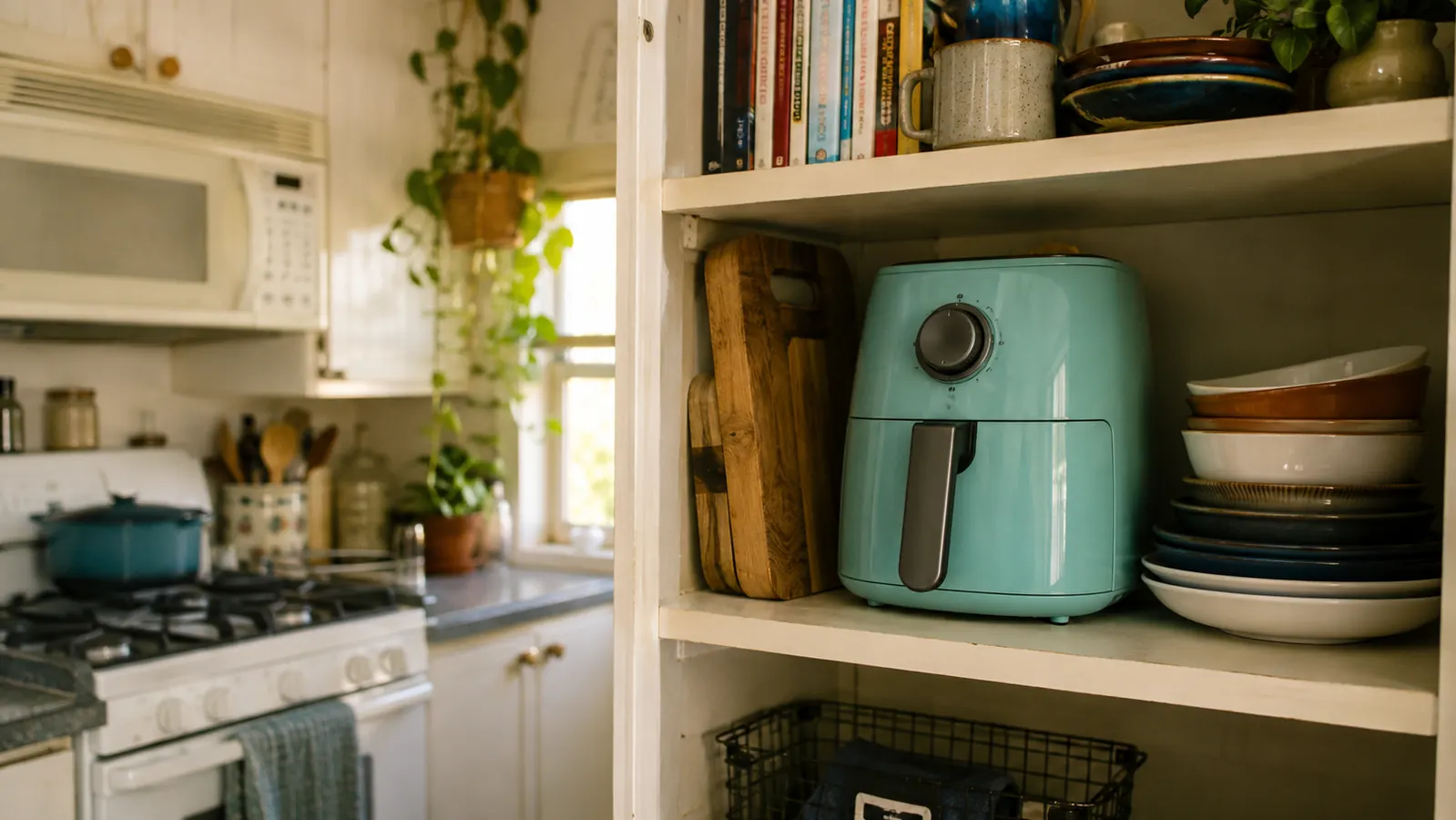
Footprint is the whole story. My counter run is twenty-four inches, and the DASH takes up 8.7 inches of that, which leaves me room for a cutting board right next to it while it runs. I actually leave it plugged in and sitting out, which is the real test of whether an appliance earns its spot in a small kitchen. The Ninja, at 11.5 inches wide and nearly 13 inches deep, ate almost half my counter by itself. I couldn't cut vegetables next to it without sliding the cutting board onto the stovetop first, so it went back in the closet between uses, and closet appliances stop getting used within a month.
The DASH is also lighter to live with day to day, about 6 pounds against the Ninja's 10.6. That matters more than it sounds like it should when you're lifting an appliance down from a shelf every single night. My upper cabinet shelf sits right around eye level, and pulling the heavier Ninja down one-handed while holding a plate in the other was not something I wanted to do at 6 p.m. on a weeknight after work. Six weeks into borrowing it, I'd started leaving it out on the counter permanently just to avoid the lift, which defeats the entire point of choosing a small kitchen appliance in the first place.
The dial controls on the Dash are also just simpler, and simple matters more once you're tired and hungry. There's no menu to scroll through, no app to pair, no touchscreen to wipe grease off with a damp towel before it registers a tap. Turn the dial to 400, set the timer to 12 minutes, done. The Ninja's touchscreen looked nice in the store, but by week two I was mostly ignoring the presets and setting temperature and time manually anyway, which meant I was paying for a feature I never actually used.
Cleanup follows the same pattern. The Dash's round basket fits in my sink at an angle without touching both sides, and it dries on the rack in a spot no bigger than a dinner plate. The Ninja's basket and separate crisper plate needed two hands and a full sink to rinse properly, and drying them both meant giving up half my dish rack for an hour. Small differences, but they're the kind that decide whether you rinse an appliance right after dinner or let it sit until morning.
There's also the matter of what sits next to it. My counter holds the Dash, a dish rack, and a coffee mug caddy, and that's it, with about two inches to spare. Add the Ninja to that same layout and the coffee caddy has to move to the top of the fridge, which means I'm reaching over the stove for it every morning. A four-inch difference in width sounds small until you're the one rearranging your whole counter around it.
The Dash also travels well, which matters if your small kitchen isn't permanent. I've packed mine into a duffel bag for two different weekend trips to a cabin with an undersized kitchenette, something I never once considered doing with the Ninja given its weight and bulk. If you're in a dorm, an RV, or a short-term rental where the kitchen itself might change in a year, that portability is worth more than it looks on a spec sheet.
Where the Ninja Wins
Capacity is the honest tradeoff, and it's a real one. The Ninja's 4-quart basket holds close to double what the Dash's 2.6-quart basket does, which means it can actually cook a full pound of chicken thighs or a real family-sized batch of fries in one load. With the Dash, I'm cooking in two rounds most nights if I'm feeding more than myself, which adds ten to twelve minutes to dinner and means the first batch is lukewarm by the time the second one finishes. If you're cooking for three or four people regularly, that second round adds up fast over a week, and the Ninja's single-pass capacity starts to matter more than its size on the counter.
The digital controls also give you more than one way to cook, which is worth something if you're trying to own fewer appliances rather than more. The Ninja's preset buttons cover air fry, roast, reheat, and dehydrate, where the Dash is really built around one function done well: crisping. If you want to dehydrate fruit slices for snacks or roast a small whole chicken without turning on the oven, the Ninja can do that without a second appliance taking up its own shelf somewhere else in the kitchen.
That versatility is a legitimate reason to pick the bigger machine if your kitchen has the depth to spare. A friend of mine with a proper L-shaped counter uses her Ninja to roast a full chicken on Sundays and reheat leftovers all week, and she'd never trade the capacity for the smaller footprint because she's never had to fight her counter for space in the first place. The right answer really does depend on inches you have, not just people you're feeding.
If you host regularly, the bigger basket also means fewer trips back and forth to the kitchen during a dinner party, since you can crisp a full appetizer tray at once instead of running two smaller batches while your guests wait. That's not a small thing if entertaining is part of how you use your kitchen, and it's the one scenario where the Dash's smaller basket becomes an actual limitation rather than just a minor inconvenience.
The one that actually earns a spot on a 24-inch counter
If your kitchen has one run of counter and no room to spare, the math points one direction. See today's price on the Dash Tasti-Crisp 2.6 Quart.
Amazon Check Today's Price on Amazon →I could cut vegetables next to the Dash without moving anything. I never could with the Ninja.
Who Should Buy Which
If you're cooking for one or two people, or your counter is under thirty inches total, the Dash Tasti-Crisp is the more honest buy. It's the one that stays out, stays plugged in, and gets used because it's not a chore to reach for or find a place for. Six months in, mine still sits in the same eight and a half inches of counter it started in, and I've never once thought about putting it away. That's the actual measure of whether a small appliance was worth buying, not the number of preset buttons on the front.
If you're feeding three or more people most nights and you've got the depth to spare, the Ninja's bigger basket will save you the second cooking round, and the extra presets might genuinely replace another appliance you'd otherwise need to buy and store separately. Just weigh that against the lift and the counter space it demands every single time you use it, because that part doesn't get easier with time.
For apartments, dorm rooms, and RVs specifically, the choice tends to be even more lopsided. Those kitchens rarely have thirty inches to give, and a lot of them don't have a dishwasher either, which makes the Dash's smaller, easier-to-hand-wash basket worth even more than the counter space alone. I'd point anyone in that situation straight to the smaller machine without much hesitation.
Before you decide, go measure your own counter and your own cabinet shelf, not just the price tag. An appliance that's too big to leave out is one you'll eventually stop lifting down, no matter how good the food coming out of it tastes on the first night you own it. I've watched enough good appliances end up in the back of a closet to trust that measurement over a spec sheet every time.
Measure your counter, then decide
Eight point seven inches wide is the number that matters if your kitchen is small. Check today's price on the Dash Tasti-Crisp and see if it fits yours.
Amazon Check Today's Price on Amazon →