

I bought the BLACK+DECKER TO1313SBD six months ago because it was the cheapest four-slice toaster oven with a real track record of reviews, and I needed something that could toast, bake, and reheat on a strip of counter that's barely 26 inches wide next to my kitchen sink. For the first two weeks I was ready to tell anyone who'd listen how happy I was with it. Then the things nobody mentions in a glowing five-star review started showing up one at a time, and I want to walk through them honestly before you decide whether this is the toaster oven that earns your counter.
None of what follows means I regret buying it. The BLACK+DECKER TO1313SBD does what it says on the box for the price it costs. But there's a gap between what the listing photos suggest and what six months of actual mornings, reheated dinners, and Sunday baking taught me, and that gap is worth reading before you click buy, not after.
The Quick Verdict
A capable budget toaster oven that does the job daily, but only if you go in knowing about the no-auto-shutoff dial, the temperature that runs hot, and the crumbs that don't all land in the tray.
Amazon Check Today's Price →Know the tradeoffs before you commit counter space to it
This is still the toaster oven I reach for every day, but I wish someone had told me the real quirks first. Check today's price and current availability, and read the honest parts below before you decide.
Amazon Check Today's Price on Amazon →How I Actually Use It Day to Day
My studio has one outlet within reach of the counter, which means the toaster oven and my coffee maker share a power strip, and I've learned to never run both heating elements at once or the strip's breaker trips. That's not a BLACK+DECKER problem, it's an apartment problem, but it shapes how I use this thing every single morning. Coffee brews first, oven goes on after, or vice versa. I mention it because if your kitchen has the same single-outlet setup mine does, plan around it before you're standing there at 7 a.m. with no coffee and no toast.
Beyond that scheduling dance, I use the BLACK+DECKER close to ten times a week. English muffins most mornings, a frozen dinner or leftovers three or four nights, and on Sundays a tray of roasted vegetables or a small batch of muffins. It replaced a two-slice toaster I'd had since college and it replaced my landlord's ancient full-size oven for anything that doesn't need to feed more than one person, which in a studio is most nights.
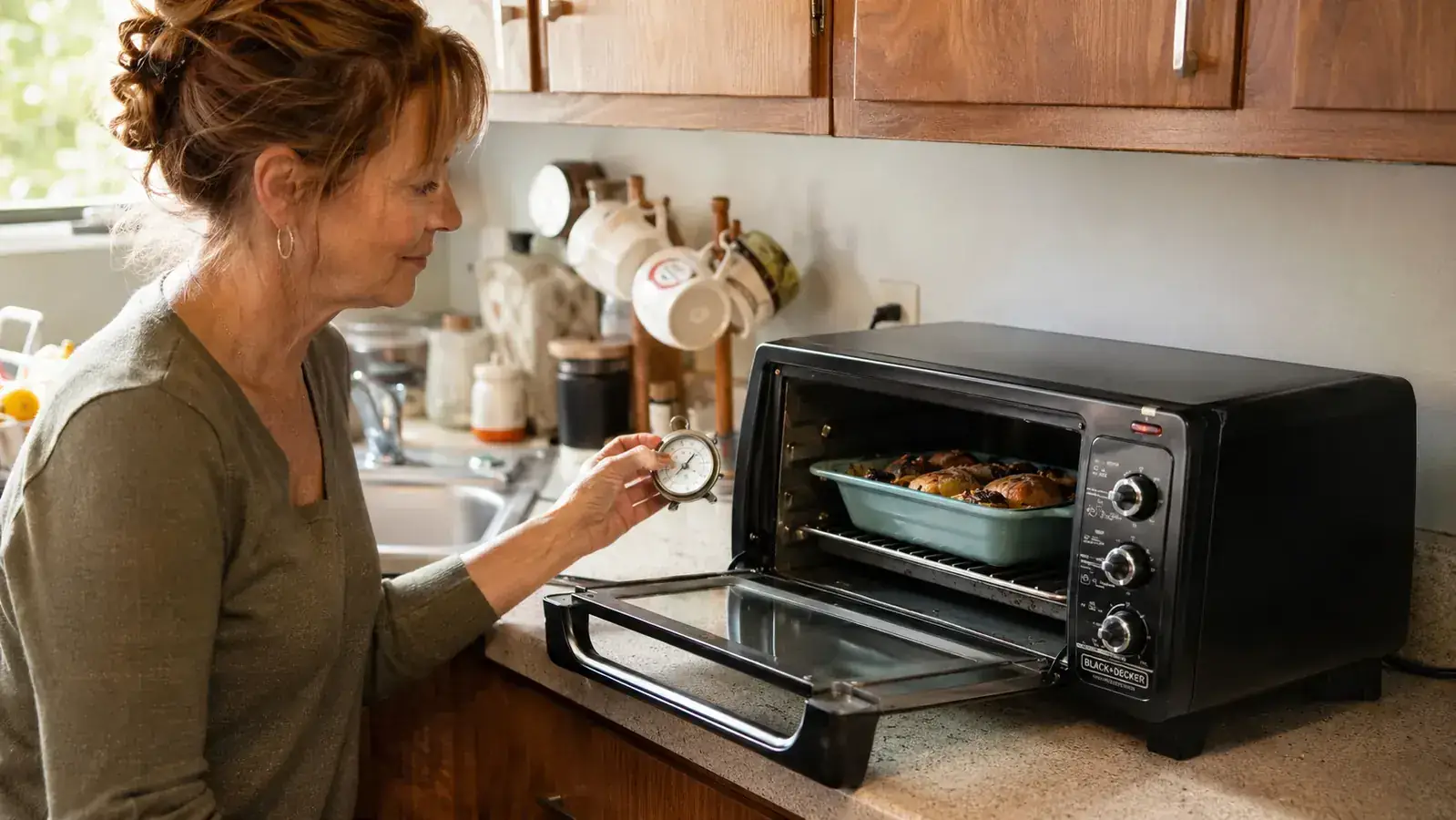
What surprised me isn't the toasting, it's how often I catch myself hovering nearby instead of walking away. There's no auto shutoff on the bake or broil dial. Once you turn it on, it stays on until you turn it back to off yourself, timer or no timer. The built-in timer only controls the bell, not the power. I've forgotten and come back to a kitchen that smells faintly of hot metal more than once, nothing burned, just a reminder that this appliance trusts you to remember it's running.
What Nobody Mentions Before You Buy
The exterior gets genuinely hot to the touch, not just the door glass but the side panels and the top vent, especially after fifteen or twenty minutes on bake at 400 degrees. I keep a folded towel between it and the wall now because the first week I noticed a faint discoloration starting on the paint behind it. Nothing melted, nothing dangerous, but if your counter setup puts anything flammable or heat-sensitive within a couple inches of the sides, you'll want to rearrange before you plug this in, not after.
There's also no interior light. I didn't think I'd care, but checking on toast or a broiling sandwich means opening the door, which drops the temperature and adds time, or squinting through a glass window that fogs up within the first few minutes of any bake over 350 degrees. I've taken to setting a phone timer for a minute less than the recipe calls for and just accepting I'll crack the door once to check, rather than trying to see anything through the glass.
The bell that signals the toast timer is finished is loud, louder than I expected from something this size, closer to an old kitchen egg timer than a soft chime. My upstairs neighbor's dog used to bark at it through the ceiling for the first month. It's a small thing, but if you're toasting at 6 a.m. in a studio where the bedroom is twelve feet from the kitchen, you'll notice.
The top vent also pushes out a steady wave of warm air while it's running, which I didn't think about until I put a bowl of rising bread dough on the counter directly beside it and came back to find one side had proofed twice as fast as the other. Now I keep anything heat-sensitive, dough, chocolate, a bowl of butter softening for a recipe, at least a foot clear of that vent side, not just the front where the door swings open.
The Preheat and Temperature Reality
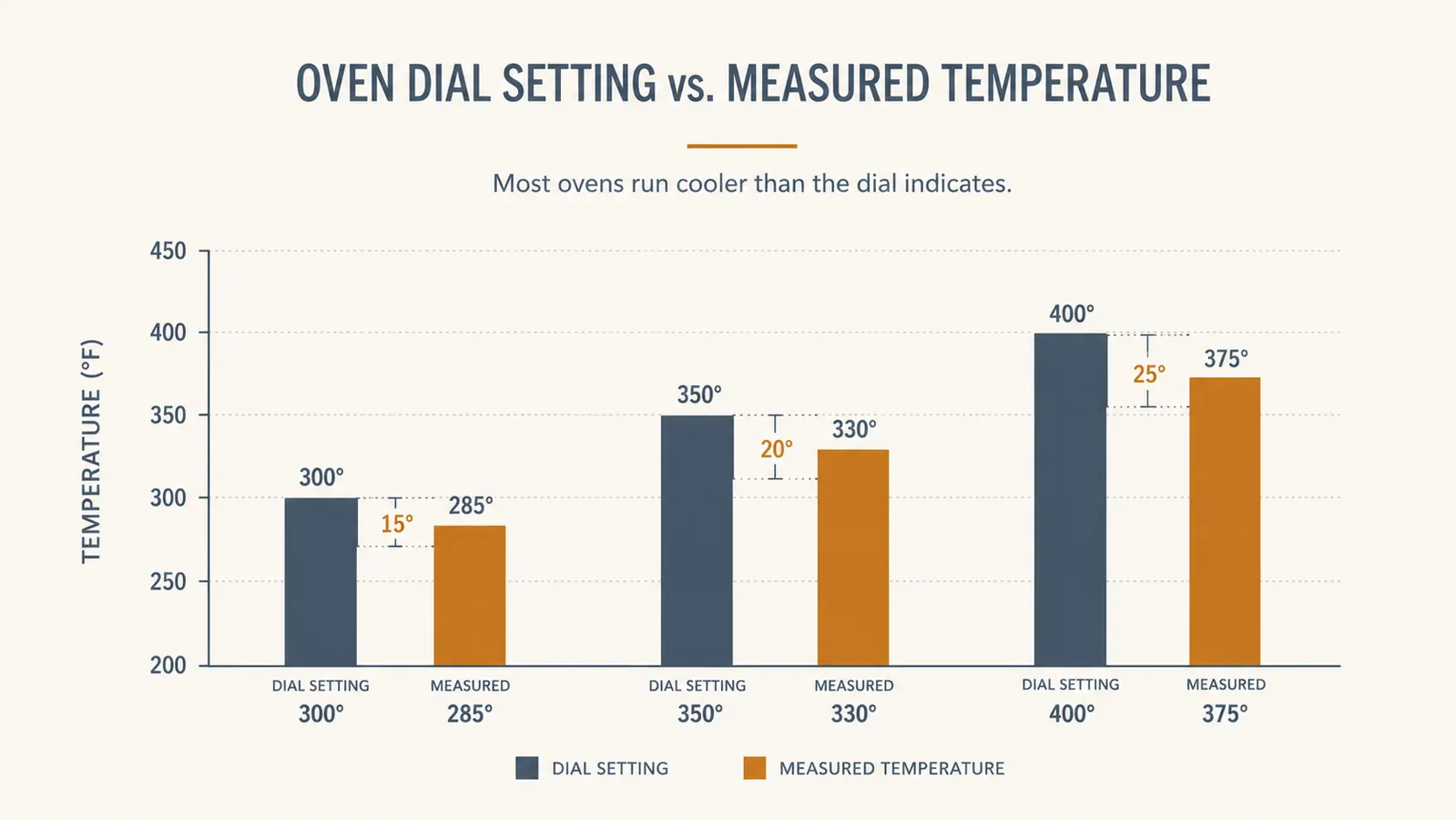
I own a cheap oven thermometer from years of baking in undersized apartment ovens, so about a month in I set it on the middle rack and ran three tests: dial set to 300, 350, and 400. At every setting, the actual measured temperature landed 20 to 30 degrees above the dial. Set to 350, it held closer to 375. That's not unusual for a mechanical dial oven in this price range, but it explains why my first two batches of cookies came out darker on the bottom than the recipe photos, and it's the kind of detail that never shows up in the spec sheet.
Preheat also takes longer than I assumed from the listing photos, which show it heating a slice of pizza almost instantly. Getting to 400 degrees from cold takes right around nine minutes by my kitchen timer, not dramatically different from a lot of countertop ovens, but if you're used to a microwave's near-instant reheat, it's an adjustment. I've started preheating the moment I start prepping dinner rather than waiting until the food is ready to go in, and that one habit fixed most of my frustration with it.
Once I knew the actual temperature ran hot, adjusting was simple. I set the dial about 25 degrees below whatever the recipe calls for and it comes out close to right. It's a five-second mental math problem now, but it took a burnt batch of garlic bread to figure out I needed to do it at all.
Cleanup Nobody Warns You About
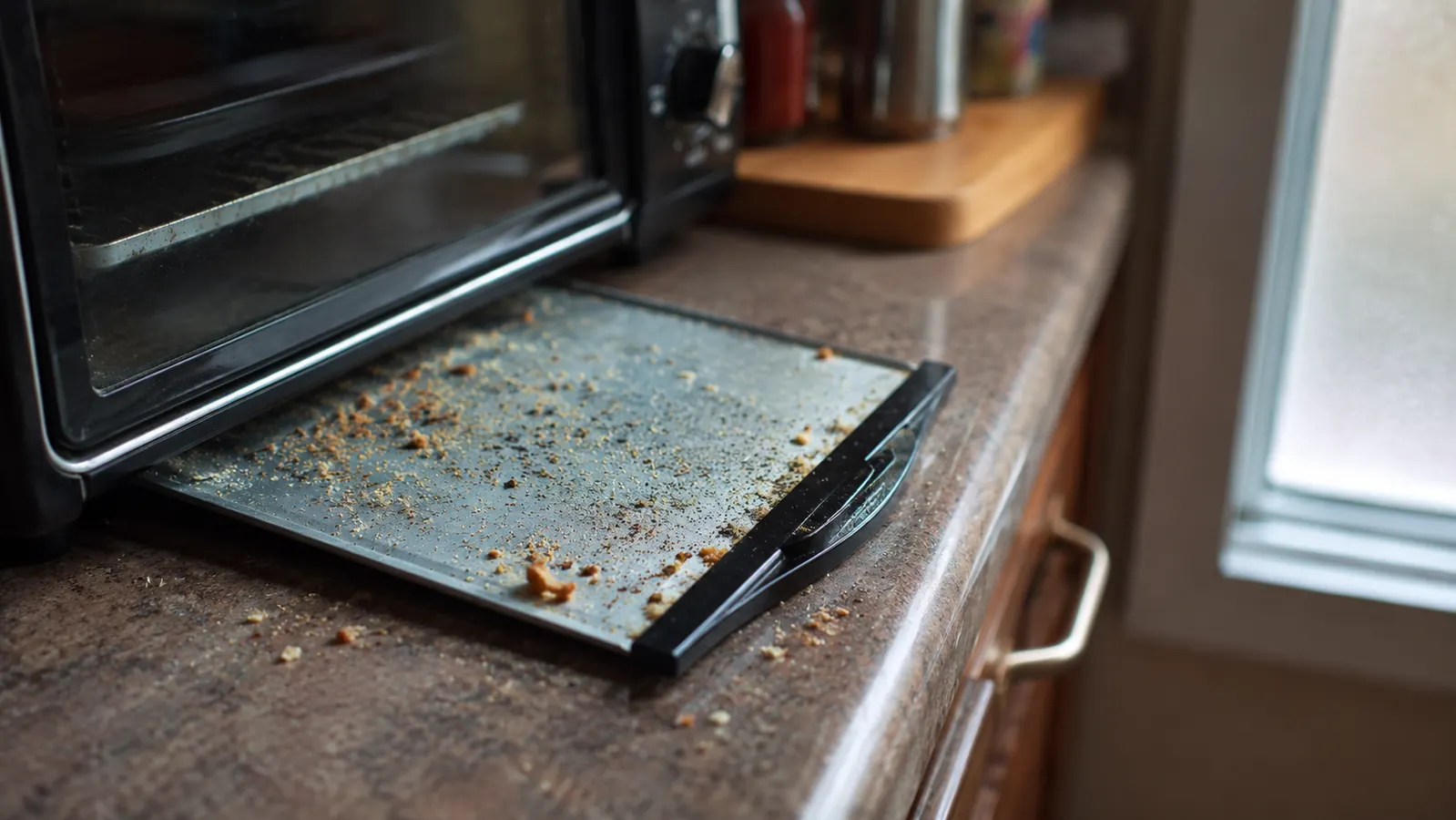
The crumb tray works, but it doesn't catch everything. Bread and bagel crumbs that land near the front edge of the rack tend to bounce off the tray lip and land on the counter instead, especially if I'm loading four slices at once and one sits slightly forward. I sweep the counter around it almost daily, which isn't a dealbreaker, just not something the product photos show you.
The first three or four uses out of the box also produced a faint burning-dust smell, stronger than I expected for a new appliance. I looked it up afterward and it's apparently common for the manufacturing residue on the heating elements to burn off during initial use, and it did fully stop by the fourth or fifth run. Still, if you're sensitive to smells in a small studio with limited ventilation, plan to run it empty for ten minutes with a window cracked before you actually cook anything in it.
The wire rack is the other cleanup surprise. Anything with cheese or sauce that drips leaves baked-on residue that a regular sponge doesn't fully lift, and after a few months I noticed the beginning of small rust-colored spots in the corners where the coating has worn thin from scrubbing. Cosmetic only so far, but it tells me the rack coating isn't built for aggressive cleaning.
There's also a thin layer of grease and dust that builds up on the top vent grille itself, something I only noticed when I finally wiped down the top of the unit and the cloth came away gray. It's not visible from normal counter height, so it's easy to forget it's there, but I've added a monthly wipe-down of the top panel to my routine since I found it, on top of the weekly crumb tray dump.
Six Months In: What's Held Up and What Hasn't
To be fair to it, the core function hasn't degraded. Toast still comes out toast-colored, bake still bakes, broil still browns the top of a casserole. The mechanical dials haven't loosened and the door still latches the way it did on day one. For a budget appliance run almost daily for half a year, that's a real point in its favor and worth saying plainly.
What I've noticed is smaller than a failure but worth flagging. The toast lever has developed a very slight give, it still clicks and holds, but it doesn't feel as crisp as it did new. And the cord, which measures about two feet, has started to fray slightly right where it meets the plug, from being coiled and uncoiled every time I move the unit to wipe underneath it. Nothing that's affected performance, but both are the kind of small wear signs that make me want to check on it again at the one-year mark rather than assume it'll coast.
I also looked into the warranty situation after the cord started fraying, mostly out of curiosity, and found the coverage on this price tier is limited and short compared to what you'd get on a pricier countertop oven. That's fine for what I paid, but it's worth knowing going in that if something fails at month fourteen, you're likely covering the replacement yourself rather than filing a claim.
Where the Marketing Oversells It
The listing photos show a family-sized spread, a full tray of nachos, a whole small chicken. In practice, this is a solo or two-person appliance. I fit four slices of bread or a personal-sized pizza comfortably, but a family dinner tray gets crowded fast, and anything wider than about 9 inches has to be angled to fit at all. If you're shopping based on the styled photos rather than the actual interior dimensions, you'll be disappointed the first time you try to fit a real weeknight meal in it.
I also want to be honest that I looked at a couple of pricier convection countertop ovens before settling on this one, models with a fan and a digital display that promised more even browning. I passed because of the price gap and the extra counter depth they needed, not because I thought this one would perform identically. It doesn't. The tradeoff is real: you're getting a smaller footprint and a lower price in exchange for hot spots you have to manage yourself and a temperature dial you have to mentally correct. That's a fair trade for my kitchen. It might not be for yours.
What I Liked
- Genuinely small footprint that fits a narrow strip of counter
- Mechanical dials with nothing to charge, sync, or update
- Toast, bake, and broil in one unit for the price of a basic toaster
- Core heating performance hasn't degraded after six months of near-daily use
Where It Falls Short
- No auto shutoff, the oven stays on until you manually turn the dial off
- Measured temperature runs 20 to 30 degrees hotter than the dial setting
- Exterior gets hot enough to discolor a nearby wall without spacing
- Crumb tray doesn't catch everything, expect to sweep the counter
- No interior light and a glass door that fogs above 350 degrees
The five-star reviews aren't lying. They're just written by people who haven't used it long enough to notice the hot walls, the hungry crumb tray, and the dial that runs a little warm.
Who This Is For
This fits someone cooking for one or two people who wants a genuinely compact appliance that does more than toast, and who's willing to learn its quirks in the first few weeks rather than expect it to behave like a full-size oven straight out of the box. If you own a thermometer, or you're willing to buy one, correcting for the temperature offset takes about five minutes to learn and then it's a non-issue. And if a mechanical dial with no digital anything sounds like a feature rather than a limitation to you, you'll be fine here.
It's also a solid pick if your kitchen setup, like mine, means it has to live in tight quarters near other appliances, as long as you give it real air on both sides rather than tucking it flush against a wall. And if you're the type who already keeps a mental list of what to watch for on any new appliance, the quirks here are minor enough to fold into that list without much friction.
Who Should Skip It
If you need to walk away from an oven mid-bake without worrying about it, whether that's because you have a toddler, a distracting job that pulls you out of the kitchen, or you just forget things, the lack of an auto shutoff is a real reason to look elsewhere. Skip it too if you're cooking for a family and need to fit a real dinner tray rather than a single portion, or if fogged glass and no interior light will genuinely bother you every time you want to check on food without opening the door. And if consistent, out-of-the-box temperature accuracy matters more to you than price, a model with digital temperature control will save you the mental math.
It's also not the right pick if your counter setup puts it within a few inches of anything you can't move, cookbooks, a wall calendar, curtains near a window over the sink. The heat it throws off the sides and top is real, and no amount of careful use changes that it's a small, hot box that needs breathing room on more than just the front.
The honest version, so you buy it with your eyes open
Six months of real use and I'd still buy it again, knowing what I know now. Check today's price on Amazon and decide with the full picture, not just the highlight reel.
Amazon Check Today's Price on Amazon →